
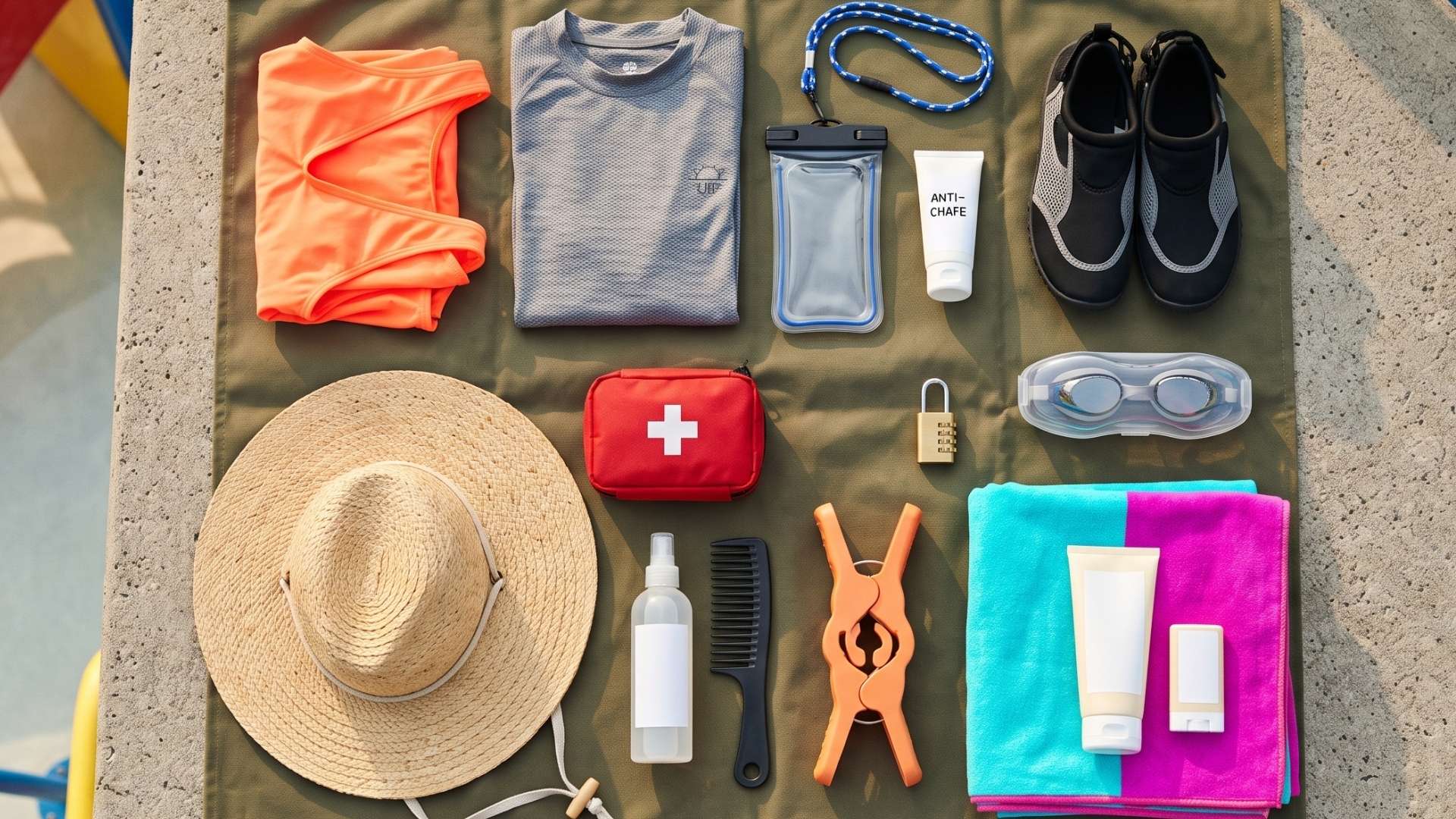
An outdoor waterpark packing list breaks into seven categories: tickets and money, sun protection, slide-safe swimwear, fitted water shoes, a locker-friendly bag, anti-chafe and grooming, and the food and drink plan (which depends on the park's rules). The most important step happens at home before you leave: check every swimsuit for metal grommets, exterior metal zippers, and hard plastic buckles, because most parks ban those on body slides.
Before you read on (a short note)
This is the deep packing list for an outdoor waterpark day with kids. For the cross-destination comparison see family water day packing. For waterpark safety specifics (wave pools, lazy rivers, slide rules, lost-kid plan), see our waterpark safety guide. For the strategic side (which park to pick, when to go, what is worth the line), see family waterpark strategy.
Pack for the rules first, then the kids
At the beach, you decide what to bring. At a waterpark, the park decides. Before you pack a single thing, check the park's current rules. The rules that matter for packing change park by park, sometimes year by year. Most parks publish them on the website's FAQ or the bag-policy page.
"At the beach you decide what to bring. At a waterpark, the park decides."
What to check on the park website before you pack
- Outside food and drink policy (most limit it; many now allow empty refillable water bottles for in-park refill stations).
- Cooler policy (most ban hard coolers; some allow small soft coolers in designated picnic areas with hand-stamp re-entry).
- Outside flotation devices (most parks provide USCG-approved life jackets for free; some allow you to bring your own; some do not).
- Swimwear hardware (most ban metal grommets, exterior metal zippers, rivets, and hard plastic buckles on body slides because the hardware damages the slide flumes).
- Bag size limits at security (some limit bag size; some require see-through bags for high-traffic times).
- Locker availability (some parks include lockers; most rent them by the day or by the rental period).
- Cashless or hybrid payment (most are cashless; a few accept cash; check before you go).
- Re-entry policy (most allow re-entry with a hand stamp or RFID wristband; some do not).
Two minutes on the park's bag-policy page saves you from a security-line surprise that costs you a re-park trip to the car.
Before you leave the house: the metal-free swimsuit check (and other home prep)
Most parents have never had to check a swimsuit for metal hardware. At a waterpark, this is the single most-overlooked pre-departure step. A kid in the wrong swimsuit gets turned away at the top of the slide stairs after waiting in the line.
Pro tip: the metal-free swimsuit pre-check
Lay out every swimsuit, rash guard, and pair of board shorts the night before. Inspect each one for metal grommets, exterior metal zippers, rivets, decorative metal studs, or hard plastic buckles. Body slides ban these because metal scratches the fiberglass slide flumes and hard plastic can cut other riders. Stick to all-fabric swimwear with internal drawstrings. If a swimsuit has a metal grommet you can clip the metal off with wire cutters; if you cannot, leave that suit at home.
What else to do at home before you leave
- Kids in their swimwear under cover-ups. Skip the changing-room wrangle on arrival.
- First sunscreen coat applied to dry skin. Mineral sunscreen with zinc oxide or titanium dioxide, SPF 30 or higher, water-resistant. Reapply every 90 minutes inside the park.
- Screenshot tickets, parking passes, QR codes, and confirmation numbers. Cell service near gates and lockers is often weak.
- Charge phones, smartwatches, a small power bank.
- Set up Apple Pay or Google Pay on the parent's phone or watch. Most parks are cashless.
- Top up water bottles with ice for the drive.
- Pack each kid's full outfit for the ride home in a labeled zip bag.
The non-negotiables: the items every waterpark bag needs
These are the items the bag is built around. They cover the gap between security check and the locker bay.
Tickets, ID, and money
- Digital or printed tickets (screenshot before you leave home).
- ID for adults.
- Payment card. A second card as backup.
- Small cash if your park still accepts it (some do for tips or specific vendors).
- Parking pass if needed.
- Membership card or season pass if applicable.
- Email confirmation saved offline on the phone.
Sun protection (full-day sun, no shade once you leave the basecamp)
- Mineral sunscreen, SPF 30 or higher, water-resistant. Zinc oxide or titanium dioxide.
- Sunscreen stick. For faces, ears, the back of the neck, and the part in the hair.
- Lip balm with SPF.
- A clean makeup foundation brush for face application on small kids (the calm-the-fight tool).
- Wide-brimmed sun hat per kid with chin strap or toggle for walking between attractions.
- Polarized sunglasses with a floatable strap (cheap floating athletic strap so they do not sink in the wave pool).
- Long-sleeve UPF rash guard or swim shirt for fair-skinned kids and longer days.
Slide-safe swimwear
- All-fabric swimsuits with NO metal grommets, exterior metal zippers, rivets, or hard plastic buckles (the metal-free check above).
- Bright neon swimsuits for crowd visibility. Neon orange, neon pink, neon yellow stay visible in a wave pool; pale blue, dark green, gray, and white disappear.
- Tight-fitting long-sleeve UPF 50+ rash guards. Loose shirts can ride up on slides or be turned away by ride attendants.
- Lightweight cover-up or zippered terry-cloth hoodie for walking through gift shops, food courts, or outdoor restaurants where swimwear-only is sometimes not allowed.
- Backup swimsuit per toddler.
- Swim diapers if needed (parks require swim diapers under specified ages or weights).
Water shoes (fitted, with heel straps)
- Fitted water shoes or athletic water sandals with secure heel straps. Flip-flops fly off on slides and trip up little feet on staircases.
- Closed-toe or sandal-style with thick rubber soles. Park concrete is hot in summer; closed-toe is gentler.
- Cheap slide-on sandals kept exclusively for bathroom runs (more on this below).
- Backup pair for the ride home (optional).
For fit and selection guidance, see water shoes for kids.
Tinted goggles (the underrated essential)
Commercial outdoor waterparks maintain high chlorine levels to keep public pools safe. After an hour or two in the water, those chemicals will irritate kids' eyes. Tinted swim goggles provide clear vision under the water while cutting blinding sun glare on the surface. Pack one pair per kid who will wear them.
Anti-chafing balm (this is not optional for full-day waterpark visits)
Walking a few miles over the course of a day in a wet swimsuit causes painful inner-thigh and underarm chafing for kids AND adults. An anti-chafe balm (BodyGlide or generic equivalent) applied to vulnerable spots before entering the park prevents the late-afternoon ouch that turns the last hour into a slow shuffle. Pack a tube; apply at the basecamp every couple of hours if a kid is sensitive to chafing.
Towels and basecamp gear
- One towel per family member, plus one extra.
- Brightly-colored or neon towels (one of the best basecamp-finding hacks; see the tip below).
- Heavy-duty plastic towel clips (the giant flamingo or peg-shaped kind). Clamp neon towels to lounge chairs.
- A small backpack or tote that fits inside a standard locker.
- A lock for the locker if the park requires you to bring your own.
Pro tip: bright neon towels with giant chair clips
Waterpark lounge chairs all look identical. From a moving lazy-river inner tube, your kids cannot pick out your row, let alone your specific chair. Clamp a bright neon towel to your home-base chairs with giant plastic towel clips (peg-shaped or animal-shaped). Kids spot the towel from across the park. Pack the clips with the towels in your home stash so they are not the thing you forget. Cheap, packs flat, saves more time per visit than almost anything else in the bag.
Phone and valuables
- Waterproof phone pouch on a sturdy lanyard. Skip the cheap pouches that fog in chlorinated steam; spend $15 to $20 on a name-brand one.
- Skip jewelry, watches (unless on a waterproof smartwatch you wear in pools), and anything you would mourn if lost in a wave pool drain.
- Tickets and ID inside the waterproof pouch with the phone.
First-aid kit (small)
- Waterproof bandages or liquid bandage (regular Band-Aids peel off on a water slide within two minutes).
- Heavy-duty waterproof strips.
- Antiseptic wipes.
- Tweezers.
- Any daily medication.
- Children's pain reliever (parent-approved).
- Allergy medication if relevant.
Grooming and after-park
- Hair detangler spray and a wide-tooth comb (chlorine plus sun plus wave-pool tumble equals a matted bird's-nest by 4 PM; ten minutes of detangling now saves a 30-minute meltdown at home).
- Leave-in conditioner spray (helpful for long hair).
- Hair ties or clips.
The locker strategy (where your day actually lives)
The locker is the secret hub of a waterpark day. Get this right and you save back-and-forth time, lost-item drama, and post-park stress.
Rent the locker early
- Rent on arrival, before the lockers run out. Most parks open lockers when the gates open; high-volume days sell out the convenient locations by 11 AM.
- Pick a locker close to your basecamp chairs. The walk back to the locker is the time tax that adds up over a day.
- Take a photo of the locker number and the row sign immediately. Phones go in pouches and brains drift after the third slide.
What goes in the locker
- Wallet, car keys, ID, backup payment card.
- Phone (in waterproof pouch) when you are riding a slide that does not allow pouches.
- Sunscreen, sunscreen stick, lip balm.
- Hair detangler, comb, hair ties.
- Anti-chafe balm.
- First-aid kit.
- Dry clothes for the ride home (some families prefer to leave these in the car; either works).
- Snacks if allowed.
- Anything you would not want to walk back to the car for.
What stays OUT of the locker
- The waterproof phone pouch on your lanyard (worn the whole day for photos and payments).
- Sunscreen stick (in the pouch or a pocket of the cover-up).
- Tickets/wristband (most parks now use wristbands that replace the locker key).
- A small amount of cash if any cash transactions are needed.
Locker etiquette and security
- Do not share your locker code with kids who cannot remember it; have one parent be the locker keeper.
- Test the locker close once. Some parks have weight-sensitive or RFID-keyed lockers that behave differently than home lockers.
- If the park uses an electronic locker, the system usually allows multiple opens for the day; do not assume one-and-done.
- Skip the temptation to use "just in case" lockers for premium gear: bring less, lock less.
The cashless payment plan
Almost every major outdoor waterpark in the US, Canada, UK, and EU is now cashless or hybrid. The wet-walking-around-with-a-wallet problem mostly solved itself. The new problem is making sure your payment method works the whole day in chlorinated water.
Pro tip: set up the cashless plan at home
Three options that all work. First, load Apple Pay or Google Pay on a waterproof smartwatch (Apple Watch, Garmin, Samsung) and pay by wrist tap. Hands always free. Second, set up the park's official RFID cashless wristband at the front gate; load funds before the slides start, top up at any kiosk. Third, keep a backup card inside the waterproof phone pouch on the lanyard. Pick one as primary; the second as backup. Do not rely on cash; most parks have stopped accepting it.
What to budget for in-park
- Locker rental ($10 to $25 typical per day).
- Food and drinks (heavily marked up; budget realistically).
- Locker-friendly midday meals if you do not tailgate (see food rules below).
- Souvenir water bottle (if the park sells a refillable one with a discount on refills, it often pays off by the end of the day).
- Optional fast-pass or skip-the-line wristband.
- Tipping cabana attendants if you book a cabana.
Food rules and the legal loopholes
Most outdoor waterparks limit outside food and beverages. The reasoning is commercial (the in-park food is the profit margin); the policy varies by chain and year. Read the current policy on the park's website before packing food.
Exceptions that almost every park allows
- Baby formula and baby food.
- Medical or allergy-specific foods (bring documentation if the allergy is severe).
- Empty refillable water bottles for in-park refill stations (increasingly common; check first).
- Sealed water bottles (some parks; not all).
- Special-needs dietary items.
Carry these items in clearly-labeled bags. If security is uncertain, ask politely at the gate and offer to explain the medical need; do not argue at the checkpoint.
Pro tip: the midday tailgate lunch (hand-stamp loophole)
If your park bans outside food but allows re-entry with a hand stamp, the family-of-five-on-a-budget loophole is the midday tailgate lunch. Pack a small soft cooler in the car with sandwiches, fruit, and drinks. Around noon, walk out of the park (kids in cover-ups, hands stamped), eat lunch at the car or at the picnic tables in the parking lot, refill water bottles, then walk back in. Budget 45 minutes for the round trip. Confirm the park allows re-entry before you go; not all do.
What to pack as snacks (if allowed inside the park)
- Squeeze applesauce pouches and yogurt pouches (no utensils, no sticky cleanup).
- String cheese in a small cooler bag.
- Pre-cut watermelon, cucumber, grapes in hard-shell containers.
- Crackers, granola bars, pretzels in snap-top cups.
- Dry cereal cups for younger kids.
- Avoid: chocolate (melts), open chips, anything that needs utensils.
In-park food strategy if outside food is banned
- Eat a real breakfast at home before you go. Cuts hunger window in half.
- Plan the in-park meal at 11:30 AM before the lunch rush or after 1:30 PM after it.
- Look for the meal-deal combos. They are not always advertised; ask at the counter.
- Carry refillable bottles if the park allows. Refill stations are the biggest in-park savings.
- Use the park's app if it has one for mobile food ordering. Saves the line.
Waterpark safety (the rules that matter beyond the bag)
Outdoor waterparks have lifeguards at every body of water, more than most beaches. The safety burden shifts from "will help arrive in time" to "will my kid be where help can see them." For the full safety primer see our waterpark safety guide and the family water safety guide.
The four non-negotiables
- A US Coast Guard-approved life jacket on every non-swimmer. Most outdoor waterparks provide them for free at attraction entrances. If your child is attached to their own well-fitting USCG-approved jacket and the park allows outside flotation devices, bring it. Skip floats, arm bands, and pool noodles; they are not flotation devices.
- A meeting spot named the moment you enter the park. The big gazebo, the entrance fountain, the specific gift shop. Walk to it with the kids and name a landmark.
- A photo of each kid as you walk through the gate showing exactly what they are wearing today. Lifeguards hear "red rash guard, neon pink swimsuit, blue water shoes" instead of guesses.
- Bright neon swimsuits per kid for crowd visibility (covered in the non-negotiables above).
The wave pool rules to tell kids before they enter
- Stay in the shallow end if you are not a strong swimmer.
- If a wave knocks you off your feet, stay calm, get to your back, kick to the shallow side.
- Never lift, hold, or push another kid in the wave pool.
- Get out when the lifeguard whistle blows, no questions.
- Meeting spot is at the chair with the neon towel and the orange clip (see above).
The lazy river rules
- One person per inner tube unless the park rule is otherwise.
- Stay in your tube; do not switch tubes mid-river.
- Watch for water-feature drops where the river dumps you out (some lazy rivers end in small slides; some empty into a pool).
- Keep your waterproof phone pouch inside the tube, not dangling.
The slide rules every parent should know
- Height and weight limits are real. The ride attendant turns kids away who do not meet them.
- Metal-free swimwear, every time.
- No jewelry on body slides (rings can damage flumes; necklaces can catch).
- No goggles on certain slides (some parks ban them; the ride attendant tells you).
- Single riders only on most body slides; double tubes for tube rides.
- Loose hair tied back is faster and safer.
Baby and toddler add-ons
Most outdoor waterparks have toddler-specific water-play areas with low or zero water depth. Babies under 1 are welcome but limited to the splash-pad-style areas; the full-park experience starts around age 2 or 3. For full age-specific lists see water day packing for a toddler and water day packing for a baby.
Babies (under 1)
- Swim diapers (parks require them under specified ages or weights) AND regular diapers. More than you think.
- Wipes (plus extra).
- Waterproof changing pad.
- Baby-safe sun hat with brim.
- Long-sleeve UPF cover-up.
- For under-6-months, the AAP advises shade and clothing first, with a small amount of mineral sunscreen on small exposed areas only if needed; ask your pediatrician.
- A baby carrier for walks between attractions.
- Feeding supplies: bottles, formula in a sealed cooler bag (this is one of the universally-allowed in-park exceptions), breastfeeding cover.
- Stroller fan if used safely (most parks allow strollers).
- A small lightweight blanket for naps in the cabana or in shade.
Plan for 2 to 3 hours maximum on a baby waterpark day. The features that work for babies are limited; the heat, crowds, and chlorine drain them faster than an open-air splash pad would.
Toddlers (1 to 3)
- Swim diapers + regular diapers (spares of both).
- Hooded towel or towel-poncho.
- Bright neon swimsuit.
- Water shoes that stay on when they run.
- Extra wipes.
- A comfort item if they have one.
- Snacks (if allowed) every 90 minutes.
- Backup outfit beyond the dry-clothes kit.
- A small toy or buoyancy aid for the toddler pool (if the park's toddler area allows it).
- Their own USCG-approved life jacket if they are attached to it AND the park allows outside flotation.
The waterpark car stash (different from the beach kit)
A waterpark car stash is lighter than the beach version because the locker holds most things during the day. The car kit is the calm-baseline-for-the-ride-home, plus the optional midday tailgate lunch.
What to keep in the car all summer for waterpark days
- Two dry towels (these never go in the park).
- A full change of clothes per kid INCLUDING dry underwear.
- A dry shirt and shorts for each parent.
- Cheap flip-flops for the ride home.
- Hair detangler, comb, hair ties (if you did not put these in the locker).
- A roll of paper towels and a trash bag.
- A package of wipes.
- Hand sanitizer.
- A box of granola bars or shelf-stable snacks (the special "car snack" for the drive home).
- Pajamas for an evening or late afternoon day.
- Backup diapers and swim diapers if you have a baby or toddler.
- A small soft cooler with sandwiches, fruit, water bottles for the midday tailgate lunch (if you are doing one).
- Phone car-charger.
The return-to-car routine
- Collect everything from the locker before the locker rental window closes.
- Use the park's actual changing rooms before walking out. Most outdoor waterparks have proper changing rooms near the locker bay.
- Towel-dry hair and detangle while still in the park's changing room.
- Apply detangler or leave-in conditioner.
- Change into the dry-clothes kit and dry underwear.
- Walk to the car already road-ready. No trunk-side changing needed.
Use the changing rooms. Most outdoor waterparks have proper ones near the lockers. Skip the trunk-as-privacy-screen routine the beach demands. For more cross-destination hacks, see beach hacks with kids.
Pro hacks and "aha" moments most packing lists never mention
The small tricks experienced parents use that change the dynamic of a waterpark day.
Before you leave home
- Screenshot tickets, parking pass, QR codes, confirmation numbers. Cell service near the gate can be weak.
- Eat a real breakfast at home. Cuts the hunger window in half.
- Apply the first sunscreen coat at home, calmly, with the foundation brush.
- Confirm the park's current bag policy, outside-food policy, refill-bottle policy, life-jacket policy. Two minutes saves a security-line surprise.
Bathroom-shoe etiquette (the dedicated cheap flip-flops)
Waterpark restrooms see massive foot traffic and the floors are wet all day. Two small habits: do not let kids walk in barefoot, and do not let them wear the same water shoes they had in the pools into the bathroom either. Keep a cheap pair of slip-on sandals exclusively for bathroom runs. Switch shoes outside the bathroom door, sandals in the bathroom, water shoes back on at the door.
On the way and on arrival
- Take a photo of each kid as you walk through the gate.
- Walk to the meeting spot together and name a landmark.
- Apply or reapply sunscreen before kids run off.
- Set up the basecamp; clip the bright towels on the chairs (see the towel-clip tip above).
- Locker rental, locker number photo, basecamp set, kids briefed on the meeting spot. Then go.
During the day
- Use the foundation brush for face sunscreen reapplications. Kids tolerate the soft brush.
- Apply anti-chafe balm at the basecamp every couple of hours if a kid is sensitive.
- Reapply sunscreen every 90 minutes from arrival.
- Hydrate aggressively. Refill bottles at every refill station you pass. Chlorinated water hides the dehydration signal.
- Pop tinted goggles on for any pool or lazy-river session over 20 minutes.
- If a slide has a strict swimwear-hardware rule, the ride attendant will tell you. Walk the kid to the basecamp, swap the suit, return. Faster than arguing.
When it is time to leave
- Start the wind-down 30 minutes before closing. The exit lines build fast.
- Hit the bathroom one more time before the changing-room rush.
- Detangle hair in the changing room, not at home (it is much faster while damp).
- Save the special car snack for the drive.
- Pajamas for late-afternoon days; kids change at the car and arrive home sleep-ready.
Hidden valuables
Most waterparks have plenty of lockers, so the rolled-diaper-key trick from the beach is unnecessary. The locker is the strategy. The only items that stay on you are the waterproof phone pouch with the phone, a card, ID, and the locker key or wristband. Everything else lives in the locker.
What to skip (the overpacking trap)
Outdoor waterparks make overpacking obvious within an hour: you carry less stuff in than out because what you brought either stayed in the locker, fit nowhere, or got banned at the gate.
- Hard coolers (almost always banned).
- Glass containers (banned everywhere).
- Large floats and inflatable rafts (the park provides them).
- Beach umbrellas and shade tents (not allowed in most parks; cabanas or shade structures are the on-site option).
- Beach chairs (parks provide lounge chairs).
- Beach toys (sand toys do not work here).
- Hard balls and high-velocity toys.
- Expensive jewelry, watches (other than waterproof smartwatches you wear in pools), and anything you would mourn losing in a wave pool drain.
- Bluetooth speakers played loud.
- Outside alcohol (banned at every park).
- Anything with metal hardware on swimsuits (the metal-free check).
- Anything you cannot fit in a locker.
If you cannot answer "what specific problem does this prevent or solve at the waterpark," leave it in the car.
The complete master checklist (print or screenshot)
Use this as your final no-thinking-needed list. Categories match the seven-category answer at the top.
Tickets, ID, and money
- Digital tickets (screenshot)
- ID for adults
- Payment card + backup card
- Small cash if needed
- Parking pass
- Membership card / season pass
- Email confirmation saved offline
- Apple Pay or Google Pay set up on phone or watch
Sun protection
- Mineral sunscreen SPF 30+
- Sunscreen stick for faces
- Foundation brush for face application
- Lip balm with SPF
- Wide-brimmed sun hat per kid with chin strap
- Polarized sunglasses with floatable strap
- Long-sleeve UPF rash guard or swim shirt
Slide-safe swimwear
- All-fabric swimsuits per kid (no metal grommets, zippers, rivets, hard plastic buckles)
- Bright neon colors (orange, pink, yellow); skip blue and white
- Tight-fitting UPF rash guards
- Lightweight cover-up or zippered hoodie
- Backup swimsuit per toddler
- Swim diapers (with spares)
Water shoes
- Fitted water shoes with heel straps per kid
- Cheap slide-on sandals for bathroom runs ONLY
- Backup pair for the ride home (optional)
Tinted goggles + anti-chafe
- Tinted swim goggles per kid
- Anti-chafe balm (BodyGlide or equivalent)
Towels and basecamp
- Towel per family member + 1 spare
- Bright neon towels (one of the basecamp markers)
- Heavy-duty plastic towel clips
- Small backpack or tote that fits in a locker
- Lock for the locker (if park requires)
Phone and valuables
- Waterproof phone pouch on a sturdy lanyard
- Backup payment card inside the pouch
- ID inside the pouch
First-aid kit
- Waterproof bandages or liquid bandage
- Heavy-duty waterproof strips
- Antiseptic wipes
- Tweezers
- Daily medication
- Children's pain reliever
- Allergy medication
Grooming and after-park
- Hair detangler spray
- Wide-tooth comb
- Leave-in conditioner spray
- Hair ties or clips
Baby and toddler add-ons
- Swim diapers + regular diapers (more than you think)
- Wipes (plus extra)
- Waterproof changing pad
- Baby sun hat with brim
- Long-sleeve UPF cover-up
- Mineral sunscreen (6+ months; ask pediatrician for under-6)
- Feeding supplies (bottles, formula in sealed cooler bag, breastfeeding cover)
- Baby carrier
- Stroller fan
- Small lightweight blanket
- Hooded towel for toddlers
- Backup outfit beyond the dry-clothes kit
- Comfort item
- Toddler's USCG-approved life jacket if attached AND park allows outside flotation
The car stash
- Two dry towels
- Full change of clothes per kid (with dry underwear)
- Dry shirt and shorts per parent
- Cheap flip-flops
- Paper towels and trash bag
- Wipes and hand sanitizer
- Granola bars / car snacks
- Pajamas for late-afternoon days
- Backup diapers and swim diapers
- Small soft cooler for midday tailgate lunch (if doing one)
- Phone car-charger
Frequently asked questions
What should I pack for an outdoor waterpark with kids?
Pack for the park's rules first. Bring tickets and ID, a payment card, a phone in a waterproof pouch on a lanyard, all-fabric swimsuits in bright neon colors (no metal hardware for body slides), rash guards, swimsuit cover-ups, fitted water shoes with heel straps, bright neon towels with giant chair clips, tinted swim goggles, anti-chafe balm, mineral sunscreen, sun hats, cheap slide-on shoes for bathroom runs, a small lock for the locker, and a small first-aid kit. Check the park's current rules on outside food, refillable water bottles, and outside life jackets before you pack.
What is the most-overlooked thing to check before going to a waterpark?
Swimsuit hardware. Most outdoor waterparks ban metal grommets, exterior metal zippers, rivets, and hard plastic buckles on body slides because they damage the slide flumes. A kid in the wrong swimsuit can be turned away at the top of the stairs after waiting in the line. Lay out every swimsuit the night before and inspect each one. Stick to all-fabric swimwear with internal drawstrings.
Do kids need water shoes at a waterpark?
Yes, strongly. Park concrete and pavement get dangerously hot in summer afternoons; you will walk several miles over the course of a day. Fitted water shoes or athletic water sandals with secure heel straps are the right choice. Flip-flops fly off on slides and trip up little feet on staircases. Keep a separate cheap pair of slide-on sandals exclusively for restroom runs.
Can I bring outside food into an outdoor waterpark?
Most outdoor waterparks limit outside food. Almost-universal exceptions include baby formula, baby food, allergy-specific foods (bring documentation if severe), and empty refillable water bottles for in-park refill stations (increasingly common). If outside food is fully banned but the park allows re-entry with a hand stamp, the family-budget loophole is a midday tailgate lunch back at the car. Always check the park's current bag policy before you go.
How do waterparks handle payments?
Most outdoor waterparks in the US, Canada, UK, and EU are now cashless or hybrid. Three options that all work: Apple Pay or Google Pay loaded on a waterproof smartwatch (pay by wrist tap, hands free); the park's official RFID cashless wristband loaded at the front gate; or a backup payment card kept inside the waterproof phone pouch on the lanyard. Set up the primary option at home before you go.
Should I bring my own life jacket to a waterpark?
Most outdoor waterparks provide USCG-approved life jackets for free at attraction entrances. If your child is attached to their own well-fitting USCG-approved jacket AND the park allows outside flotation devices, bring it. Check the park's outside-flotation policy before packing it; some parks do not allow them. Skip inflatable arm bands, pool noodles, and floats; those are toys, not flotation devices.
How do I keep track of my kids in a busy outdoor waterpark?
Three habits. First, dress everyone in bright neon swimsuits (orange, pink, yellow) for crowd visibility. Second, take a photo of each kid as you walk through the gate showing exactly what they are wearing. Third, name a meeting spot together on arrival; pick a landmark (the big gazebo, the entrance fountain, the gift shop). Clip bright neon towels with giant plastic chair clips to your basecamp chairs so kids can spot the spot from across the park.
What should I NOT bring to an outdoor waterpark?
Skip hard coolers (almost always banned), glass containers, large floats and inflatable rafts, beach umbrellas or shade tents, beach chairs, sand toys, hard balls, expensive jewelry, watches that are not waterproof, Bluetooth speakers played loud, outside alcohol, and any swimwear with metal grommets or exterior zippers (banned on body slides). Also skip anything you cannot fit in a locker.
What is the single best pro hack for a waterpark day with kids?
Bright neon towels clamped to your basecamp chairs with giant plastic towel clips. Waterpark lounge chairs all look identical, and from a moving lazy-river inner tube your kids cannot pick out your row. Clipped neon towels mark your spot from across the park. Pack them with the towels in your home stash so they are not the thing you forget. Cheap, packs flat, saves more time per visit than almost anything else in the bag.