
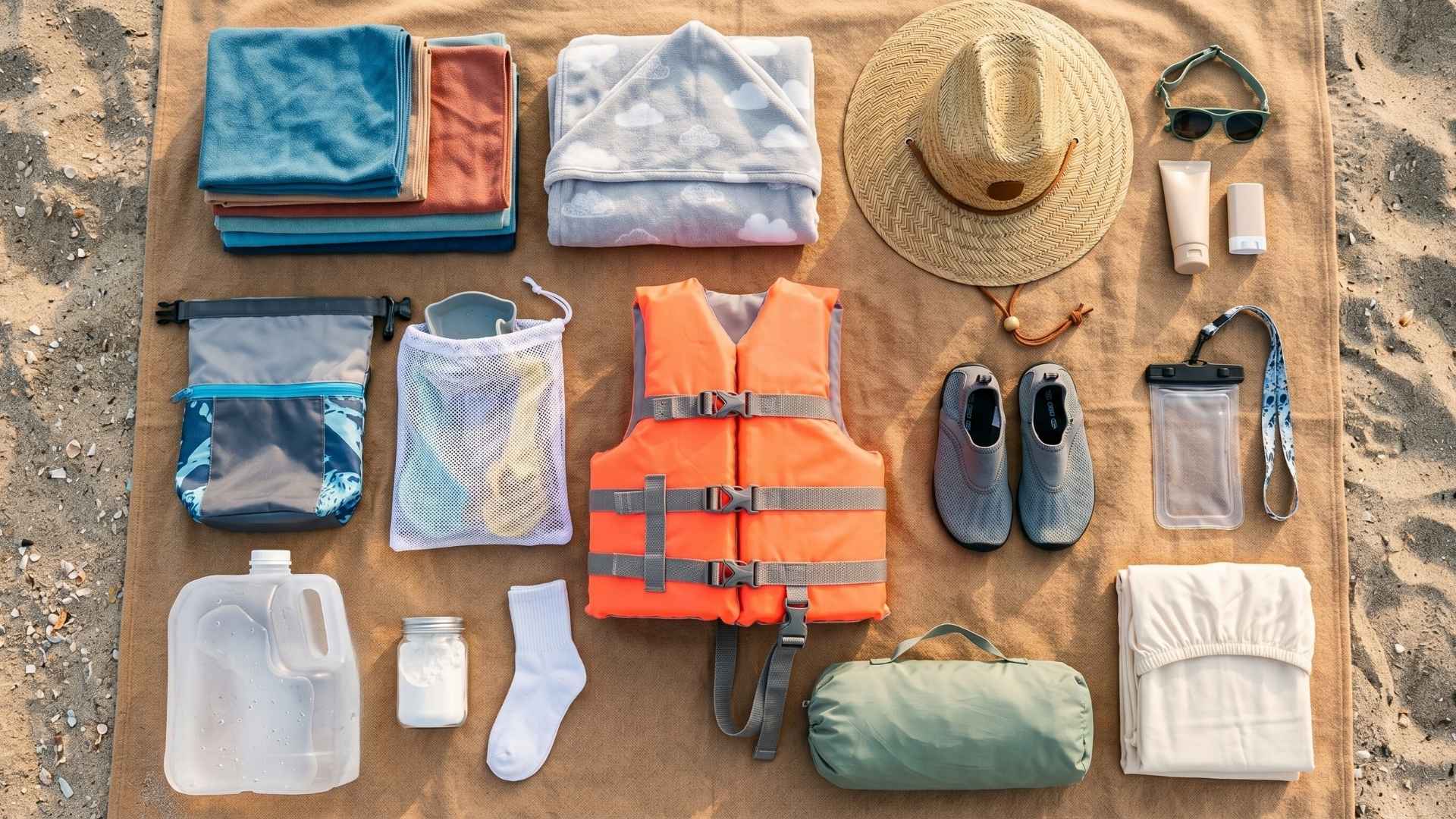
A complete family beach packing list breaks into seven categories: sun protection, water clothing, dry clothes (including the most-forgotten item: dry underwear), towels and a wet-bag system, food and hydration, safety, and the car stash for the ride home. Add a sand-management kit, and for rocky shores swap in closed-toe water shoes and a thicker blanket. The rest of this guide is the master list, organised so you can pack the bag without thinking.
Before you read on (a short note)
This is the deep packing list for a family beach day. For the safety arc that sits alongside the packing, see our family water safety guide and our open water and beach safety guide. For sun protection specifics, see the family sun safety guide. For the cross-destination pillar that compares beach, splash pad, and waterpark packing, see family water day packing.
The seven-category answer (so you can start filling the bag)
Most families overpack because they pack item-by-item. Pack by category instead and the bag almost fills itself.
- Sun protection: sunscreen, sunscreen stick, sun hats, sunglasses, rash guards, lip balm with SPF.
- Water clothing: swimsuits (bright neon), water shoes, sandals.
- Dry clothes: a full change per kid, including dry underwear and a light sweater for the ride home.
- Towels and wet-item control: one towel per person plus one spare, a dual-side wet bag, sandy-item bag, trash bag.
- Food and hydration: insulated water bottles, refillable jug, snacks that survive heat, lunch if it is a long day.
- Safety: US Coast Guard-approved life jacket per non-swimmer, bright swimsuit for visibility, ID bracelet or card, named meeting spot.
- The car stash: the permanent trunk bin that handles the ride home with dry towels, dry clothes, flip-flops, water jug, paper towels, snacks.
These seven categories repeat across every beach day; the depth of each category scales with the trip length. Pack heavy for an all-day beach trip, lighter for a 90-minute drop-in.
"Bring fewer toys and more shade, water, towels, and dry clothes."
Before you leave the house: what kids should already be wearing
The smoothest beach day starts in the bathroom at home, not in the parking lot. Get kids dressed in their water clothes before you load the car. You skip the changing-room logistics, the kids arrive ready to play, and the first sunscreen application happens calmly without sand in it.
What goes on at home, before anything else
- Sunscreen, the first coat, applied to dry skin. Reapplied every 90 minutes from arrival.
- Long-sleeve UPF 50+ rash guard or swim shirt. Cuts the area you have to sunscreen by roughly half.
- Bright, high-visibility swimsuit. Neon orange, neon pink, or neon yellow stay clearly visible in water. Skip blue and white (they disappear under the surface).
- Wide-brimmed sun hat with a chin strap. The strap is what keeps it on in coastal wind.
- Polarized sunglasses for kids who will wear them, with a flexible rubber frame and a strap.
- Water shoes or sandals. Closed-toe water shoes if you are headed to a rocky beach (see the dedicated section below).
- A light cover-up or robe towel to wear over the swimsuit on the walk to the beach.
Apply the first sunscreen coat at home. Kids are calm, dry, and there is no sand. Once you arrive every application is fighting both the sand and the kid.
The non-negotiables: the items every family beach bag needs
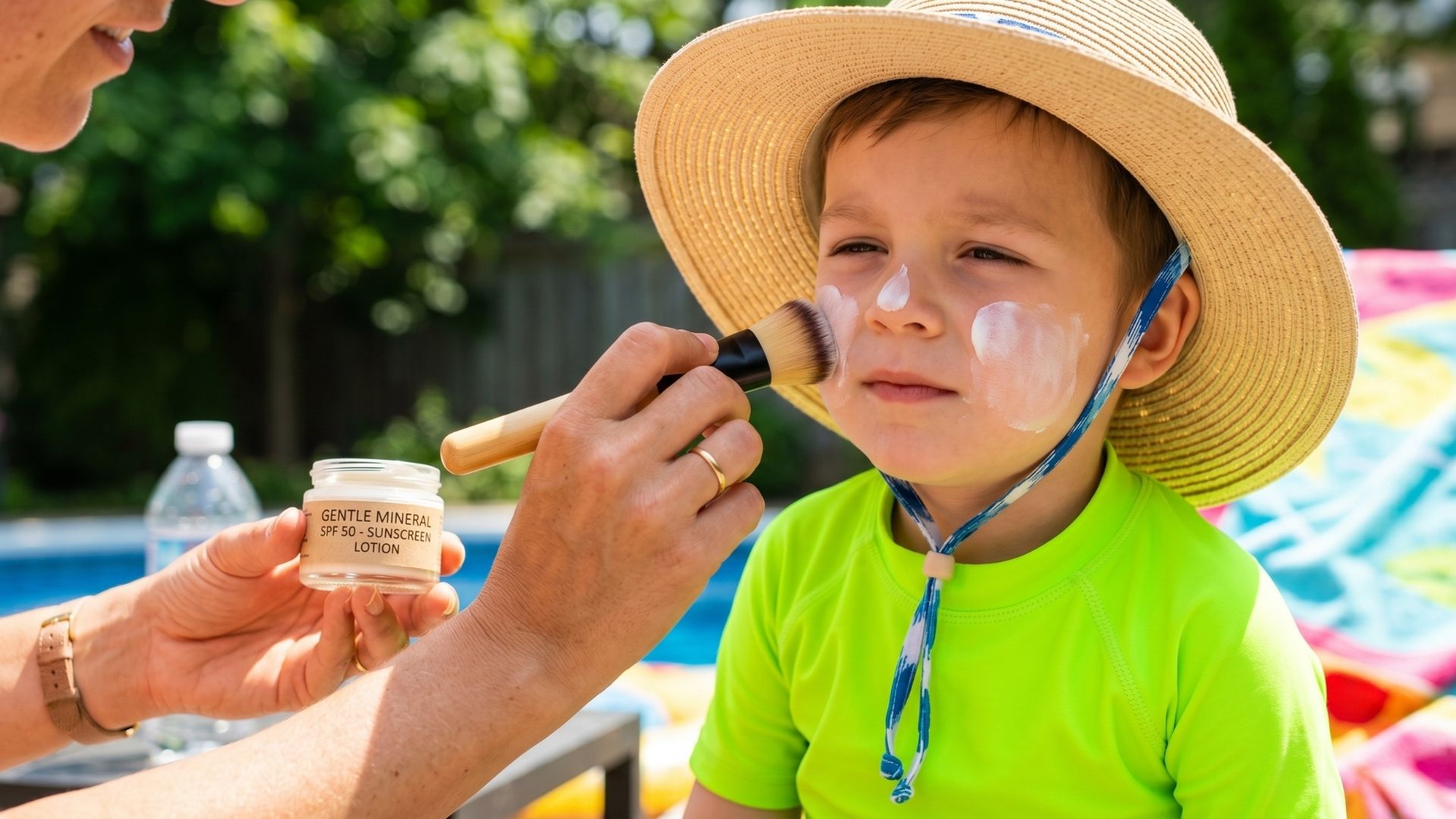
These are the items the bag is built around. Every beach day, every age, every shore.
Sun protection (the part most parents skimp on at the wrong moments)
- Broad-spectrum mineral sunscreen, SPF 30 or higher, water-resistant. Zinc oxide and titanium dioxide are the two active ingredients the FDA has identified as generally recognized as safe and effective for kids.
- A sunscreen stick. For faces, ears, the back of the neck, and the part in the hair. Lives in the beach bag year-round.
- Lip balm with SPF. Lips burn faster than parents expect, especially with water reflection.
- A clean makeup foundation brush. For kids who hate the hand-rub-on, dabbing mineral sunscreen with a soft brush is the calm-the-fight tool. Replace once a season.
- Sun hats with brims and chin straps (one per kid). Backup hats for toddlers who throw them.
- Polarized sunglasses, ideally with a strap.
- Long-sleeve UPF rash guards or swim shirts per kid.
- A pop-up beach tent or wind-friendly sun shade. Standard umbrellas catch coastal breeze and fly away, which is dangerous on a crowded beach.
- Sand-screw anchors if you must use an umbrella.
On reef-destination travel: Hawaii, the US Virgin Islands, Aruba, Bonaire, and Palau restrict sunscreens containing oxybenzone and octinoxate. Several Mexican biosphere reserves apply similar restrictions. Mineral-only formulas avoid the question entirely.
Water clothing
- Swimsuit per kid in a bright, high-visibility neon color (orange, pink, yellow). Avoid blue, white, gray, dark green.
- Backup swimsuit per toddler.
- Rash guard or UPF swim shirt per kid.
- Water shoes or sandals that stay on when kids run.
- Swim diapers if needed. Bring spares: disposable swim diapers handle solids, not urine.
Dry clothes (the category families forget at the wrong moment)
- Complete dry outfit per kid: shirt, shorts, dry underwear, optional hoodie.
- Dry underwear. The single most-forgotten item. Sitting in a damp swimsuit on the drive home causes severe chafing.
- Light sweater or hoodie for the ride home. Kids get cold faster than expected once wet hair touches a car seat.
- Dry shirt and shorts for each parent. The wet-toddler-hug arrives within 30 seconds of you sitting down.
- A robe towel or cover-up for changing.
Towels and wet-item control
- One full-size towel per family member, plus one extra for emergencies (spills, cold kids, sandy hands).
- Compact microfiber towels for backups (pack down to the size of a water bottle, dry in 15 minutes).
- Hooded towel for toddlers (warms them faster than a flat towel).
- A dual-compartment wet bag: dry clothes on one side, soaked swimsuits on the other.
- A separate bag for sandy items.
- A small trash bag, plus a wet-bag for diapers.
Parent essentials
- Phone in a waterproof pouch on a lanyard. Skip the budget pouches that fog in salt air; spend $15 on a name-brand one.
- Keys, wallet, ID, payment card, a little cash.
- A solar-powered or pre-charged power bank.
- Printed or saved tickets if needed (some private beaches require entry passes).
- A dry shirt and shorts for each adult.
The sand-management kit (the war you cannot win, but can negotiate)
Sand is going home with you. The goal is to slow it down and choose where it ends up.
What goes in the bag for sand control
- A small canister or jar of cornstarch. The headline sand-removal hack.
- A clean cotton sock to use as a powder puffer (see the pro tip below).
- A small whisk broom, soft brush, or lambswool duster for dry sand.
- Mesh laundry bag for toys (dollar-store kind for delicates is perfect).
- Mesh seashell bag per kid for collecting (some beaches restrict taking anything; check rules).
- Small spray bottle of water for sandy hands and hot feet.
Pro tip: the cornstarch sock
Pour a cup of cornstarch into a clean cotton sock and tie off the end. Now you have a soft puffer to dab onto skin instead of clouds of powder in the air. Used right before kids get into the car. Dab on sandy skin, brush off, sweep with the whisk broom, into the car. Between trips, keep the loaded sock in a sealed zip-top bag in the beach bin. Cornstarch is the safer choice over talc-based baby powder.
Pro tip: the fitted-sheet sand barrier
An old fitted sheet (the elastic-cornered kind from a bed) becomes a low-walled play zone. Lay it on the sand with the elastic side facing up. Weight each corner with the cooler, a chair, a bag of damp sand, or a heavy beach bag. The corners stand up like short walls. Sand cannot blow into the center, which gives you a clean zone for snacks, sunscreen, naps, and babies.
Things that live in the trunk for sand control
- A plastic laundry basket or large bin for the sandy gear pile.
- A cheap rubber or plastic doormat. Set on the asphalt by the open car door so kids stand on it during the rinse and change.
- A one-gallon (about 4-litre) container of tap water for foot rinsing. A clean milk carton, juice jug, or sturdy reusable bottle of that size all work.
- Paper towels and a trash bag.
- Wipes.
Pro tip: the warm-water-jug trick
Fill the one-gallon (about 4-litre) container with hot tap water right before you leave the house. Wrap it in a thick towel and stash in the trunk. Hours later the water is still warm. Pouring a warm rinse over cold beach feet at the end of the day is much kinder than ice-cold tap water, and kids cooperate with it. This is the single most under-used hack on the list.
Food, hydration, and the cooler
Beach meltdowns are heat or dehydration in disguise. Pack defensively.
Water and drinks
- Insulated stainless-steel water bottle per family member, packed with ice.
- A refillable water jug for the cooler.
- A second un-frozen container in the car for foot rinses.
- Electrolyte drinks for long, hot days (optional).
- Coffee for parents (in a secure travel mug).
Pro tip: the frozen-jug double duty
Freeze a one-gallon (about 4-litre) container of water the night before. A clean empty milk carton, a sturdy reusable jug, a juice bottle, or any food-safe container that size all work. In the cooler it is the main ice block, chilling everything else for hours. As it slowly melts, it becomes cold drinking water by lunchtime. Two products out of one frozen jug.
Snacks and lunch
Pack hydrating snacks that survive heat and one or two filling options.
- Pre-cut watermelon, cucumber, grapes, berries, orange slices, melon cubes. Mostly water, easy to eat with one hand, stay appealing in heat.
- Hard-shell containers for cold snacks (cheap soft bags get crushed under towels).
- Cheese sticks in a cooler bag.
- Yogurt pouches in a cooler bag.
- Sandwiches, wraps, or bagels for lunch.
- Hard-boiled eggs for protein on long days.
- Crackers, granola bars, dry cereal in snap-top cups.
- Frozen juice pouches or frozen grapes. By midday they are slushy and refreshing.
What NOT to bring as snacks
- Chocolate or sticky bars (melt fast).
- Open chips or sandwich bread (seagulls dive-bomb them).
- Anything with raw mayonnaise or egg in a soft cooler.
- Loose ice in the cooler. Use sealed ice packs, frozen water bottles, or the frozen jug instead.
Cooler strategy
- Pre-chill the cooler in the garage or fridge overnight. Holds cold for substantially longer than a warm cooler with the same ice.
- A soft-sided backpack cooler is much easier to carry across sand than a hard rolling one.
- Hard coolers are fine for the car stash but skip them for the beach itself.
- Set up a no-sand food zone on one corner of the blanket. Kids eat sitting down, not walking through sand.
Safety items that matter more than every hack on the list
Five rules. None negotiable. For the full safety primer, see our open water and beach safety guide and the family water safety guide.
Life jackets, ID, and visibility
- A US Coast Guard-approved life jacket sized to your child's weight (snug at shoulders and chest) for every non-swimmer. Inflatable arm bands, pool noodles, and floats are toys, not flotation devices. The American Academy of Pediatrics and the US Coast Guard agree.
- Bright high-visibility swimsuits (neon orange, pink, yellow). Skip blue and white. The color you pick at the store affects how fast anyone can find your child if they go under.
- Waterproof ID bracelet for kids, or a card with the parent phone number in each kid's bag.
- A photo of each child taken at the start of the day showing exactly what they are wearing. The lifeguard hears "red rash guard, neon yellow swimsuit, blue Crocs" instead of guesses.
The first ten minutes of the beach day
- Set the shade and secure it before anyone wanders off.
- Apply sunscreen if you did not at home, reapply if you did.
- Walk to and name a clear family meeting spot together. A landmark works best: "our orange umbrella by the third lifeguard tower."
- Take a photo of each kid showing what they are wearing.
- Name the water-watcher: one adult on duty at a time, phone away, no book, no conversation that pulls eyes off the kid. Trade shifts every 20 minutes if you have another adult.
First-aid kit
- Waterproof bandages or liquid bandage.
- Antiseptic wipes.
- Tweezers (for shells, splinters, tentacle bits).
- A small bottle of white vinegar for jellyfish stings at coastal beaches. Tap water makes jellyfish stings worse; vinegar inactivates remaining stinging cells on most common species. Mayo Clinic guidance covers the rest of the first-aid steps.
- Any daily medication.
- Children's pain reliever (one parent-approved version).
- Allergy medication if relevant.
- Aloe or after-sun lotion (kept cool).
The hot-sand and hot-pavement rule
On a hot day, dark and dry sand can both burn small feet within seconds. Water shoes with closed toes are the answer for the walk from the parking lot to the water at midday. See the family water shoes guide for fit and selection.
Dig shallow holes, fill them in
Deep beach holes are dangerous for two reasons: sea turtle hatchlings can fall into them at nesting beaches, and at dusk an unmarked hole is a broken-ankle waiting to happen. Dig shallow play holes and fill them before you leave.
Rocky beach add-ons (when your shore is shells, stones, or algae)
Rocky beaches need different gear than soft sandy beaches. The risks are slippery rocks, sharp shells, uneven ground, and uncomfortable sitting areas.
What to add to the bag for a rocky beach
- Closed-toe water shoes with thick rubber soles and reinforced toes. Thin aqua socks do not protect on sharp rocks. A fitted water shoe with a heel strap and grip is what works.
- A thicker blanket, foam mat, or foldable seat pad. A thin sheet is miserable on rocks.
- Beach chairs may matter more than a blanket on a very rocky beach.
- Extra waterproof bandages. Cuts and scrapes are more common on rocky shores.
- A bucket or mesh bag for kids who want to collect shells, stones, or sea glass.
- Lightweight gardening gloves for tide-pool exploring.
- Extra socks for the ride home (in case shoes were soaked).
- Lightweight knee pads for toddlers who crawl or climb on rocks.
Teach kids one rocky-beach rule before they leave the blanket
Step on dry rocks, not wet green or dark rocks. Wet algae is extremely slippery and is the single biggest reason kids slip and bang shins on a rocky shore. One sentence, said before they leave your spot, prevents most rocky-beach injuries.
Baby and toddler add-ons (the gear that gets you through the first three hours)
The smallest beachgoers need the most gear and run the shortest clock. Plan around shade, naps, feeding, and a real exit window. For the full toddler-specific list, see water day packing for a toddler. For under-one, see water day packing for a baby.
Babies (under 1)
- Swim diapers AND regular diapers (more than you think).
- Wipes, plus extra wipes.
- Waterproof changing pad.
- Baby-safe sun hat with a brim.
- Lightweight long-sleeve UPF cover-up.
- For under-6-months, the AAP advises shade and clothing first, with a small amount of mineral sunscreen on exposed skin only if needed; ask your pediatrician.
- A baby-specific shade tent or the shaded side of a pop-up.
- Feeding supplies: bottles, formula in a sealed cooler bag, breastfeeding cover.
- A baby carrier (often easier than a stroller on sand).
- Stroller fan if used safely.
- A small lightweight blanket for naps.
Keep baby beach trips short. Plan around naps and feedings, stay in shade, leave before everyone is exhausted.
Toddlers (1 to 3)
- Swim diapers and regular diapers or potty supplies. Spares of both.
- Hooded towel (warms them faster, doubles as a cover-up).
- Bright neon swimsuit (toddler-spotting matters).
- Water shoes that stay on when they run.
- Extra wipes.
- A comfort item if they have one.
- Snacks every 90 minutes (toddlers run out of fuel faster than the schedule expects).
- A backup outfit beyond the dry-clothes outfit (toddlers are creative).
- A small inflatable kiddie pool or a clear shower-curtain liner pressed into a shallow hole and weighted with sand. Filled with sea water hauled by bucket, this gives an intimidated toddler their own contained ocean next to your chair. Hours of contained play.
The toddler beach trick: place a bright towel, umbrella, or beach mat and tell your toddler, "This is our spot." Not a substitute for supervision, but it creates a clear home base they can find.
Beach toys: bring fewer, choose better
The toy aisle wants to sell you a $40 sand kit. Your kid will be just as happy with $6 of kitchen junk. Bring fewer, bring things that double as something else.
What actually works
- Bucket and shovel set (the classic).
- Dollar-store kitchenware: funnels, ramekins, plastic measuring cups, big spoons, silicone spatulas, a stainless-steel mixing bowl, a colander.
- Mesh seashell bag per kid for collecting.
- Bubbles for younger kids during shade breaks.
- Kite (uses the coastal wind that was working against your umbrella).
- A soft foam ball.
- Waterproof cards or a small travel game for breaks.
- Snorkel gear for older kids at calm beaches with clear water.
- Boogie board for waves, where conditions allow.
What to skip
- Toys with many small parts (get lost in sand within an hour).
- Hard balls and high-velocity toys near crowds or babies.
- Large inflatables on windy days (become projectiles).
- Battery-powered noise toys (the waves are the soundtrack).
- Anything expensive or breakable.
The end-of-day toy clean-up
Put every sand toy in the mesh laundry bag. At the end of the day, dunk the whole bag in the surf, shake it twice, and the sand stays at the beach. Toys come home clean and the bag dries in 20 minutes.
The water-day car stash (the trunk kit that saves the ride home)
The single best beach-day investment costs almost nothing: a plastic bin in your trunk that stays packed all summer. Whatever happens at the beach, the car stash is the dry, calm baseline waiting for you at the end of the day.
What lives in the car stash, all summer
- Two dry towels (these never go on the beach).
- A complete spare change of clothes for each kid, including dry underwear.
- A dry shirt and shorts for each parent.
- Cheap flip-flops for everyone.
- A plastic laundry basket or large bin for sandy, wet gear.
- A cheap rubber or plastic doormat (set on the asphalt by the open car door; kids stand on this for the rinse and change).
- A one-gallon (about 4-litre) container of tap water for the foot rinse.
- A roll of paper towels and a trash bag.
- A package of wipes.
- Hand sanitizer.
- A box of granola bars or shelf-stable snacks (the special "car snack" not eaten at the beach).
- Backup diapers and swim diapers if you have a baby or toddler.
- Sunscreen stick (the one in the bag will likely get hot).
- Pajamas for late evening outings (kids change at the car and arrive home ready for bed).
How to actually get kids out of wet swimsuits and into the car
The cleanest exits avoid changing kids at the trunk altogether. Best options ranked by privacy:
- A pop-up changing tent. Sets up in 10 seconds, packs to the size of a frisbee, gives any age kid a private spot to change. $25 to $50.
- A hooded changing poncho (swim poncho, dryrobe). Goes on over the swimsuit. Kid takes off the wet swimsuit underneath and puts on dry clothes through the bottom. Great for ages 4 and up.
- A large hooded towel wrap. For little ones not ready for a poncho. Wraps around the kid; parent helps change underneath.
- On-site changing rooms or shower stalls. Many state-park beaches and resort beaches have these. Use them when they exist.
- Cabanas or rented beach huts at resort properties that offer them.
- The trunk-as-privacy-screen fallback. Open the hatchback (SUV/wagon) or rear passenger door (sedan) so the open door blocks the line of sight. Stand the kid on the rubber doormat. Warm-water foot rinse. Dry clothes on, including dry underwear. Wet swimsuit goes into the laundry basket in the trunk.
The five-minute return-to-car routine (when nothing fancier is available)
- Towel-dry the kids and brush off as much sand as you can (cornstarch sock helps).
- Open the trunk or back door for a privacy screen.
- Put the rubber doormat on the asphalt; the kid steps onto it.
- Warm-water rinse over feet and legs from the gallon jug.
- Dry clothes on, including dry underwear.
- Buckle everyone in, then hand out the special car snack.
Pro hacks and "aha" moments most packing lists never mention
The small tricks experienced families use that change the dynamic of a beach day. For the full hack roundup, see beach hacks with kids.
Before you leave home
- Pack each kid's full outfit in a labeled zip bag (shirt, bottoms, dry underwear, fresh swim diaper if needed). After they change, the wet swimsuit goes back into the same bag.
- Charge phones, smartwatches, and a power bank.
- Pre-apply sunscreen on small kids while they are still calm.
- Freeze a few juice pouches alongside the frozen water jug.
- Fill the foot-rinse container with HOT tap water and wrap it in a towel (stays warm for hours; see the warm-water-jug pro tip above).
On the way and on arrival
- Take a photo of where you parked. Beach lots blur into each other by late afternoon.
- Take a photo of each child showing what they are wearing.
- Name the family meeting spot together before kids leave the blanket.
On the blanket
- Use a face brush or makeup sponge to apply mineral sunscreen on faces (kids hate sandy parent-hands rubbed onto their cheeks).
- Apply lip balm with SPF every reapplication.
- Keep sunscreen in a cooler pocket so it does not heat up and separate.
- Bring a small spray bottle of water for sandy hands and hot feet.
- A clip or carabiner on the umbrella holds the bug spray, sunscreen, kids' hats, and the mesh shell bag.
- A bright ribbon or scarf tied to the top of the umbrella helps kids spot your spot.
When it is time to leave
- Start packing 20 minutes before everyone is fully spent.
- Use a clear 15-10-5-minute warning system: "in fifteen minutes we dry off, in ten we put shoes on, in five we walk to the car."
- Give each kid a job: carry the bucket, hold the towel, put water shoes in the bag.
- Save a special "leaving snack" you do not bring out of the cooler until it is time to go. Turns the transition into a treat instead of a fight.
- Pajamas at the car turn a late beach day into a sleep-friendly drive home.
Hidden valuables (the rolled-diaper trick)
- Roll your car keys and a small wallet into a clean disposable diaper, fold it like a used one, and leave it on the towel. No one steals what looks like a soiled diaper.
- Or dig a shallow hole under your towel and hide a small pouch in it.
- Or use a waterproof phone pouch on a lanyard for the essentials.
The year-round beach bin
Keep a permanent bin at home with sunscreen, hats, towels, sand toys, water shoes, the cornstarch sock (in a zip-top bag), the fitted sheet, and the mesh laundry bag. Next trip, it is already packed. Add only the food, water, and dry clothes.
What to skip (the overpacking trap)
Cutting the right things from your bag is what makes the rest of the list feel light. These items sound useful and reliably are not.
- Too many toys (kids will play with sand, water, sticks, and one shovel; ten plastic molds are nine too many).
- Glass containers (banned at most beaches; not worth the risk anywhere).
- Expensive jewelry, watches, or electronics without protection.
- Large floats and inflatables on windy days.
- Hard balls and high-velocity toys near babies, toddlers, or crowds.
- Snacks that melt: chocolate, sticky granola bars, popsicles outside a cooler.
- Complicated outfits. The dry-clothes kit should be a t-shirt, shorts, and underwear, full stop.
- Heavy coolers for a short visit (a soft cooler for 90 minutes is plenty).
- Bluetooth speakers played loud.
- Anything you cannot carry across sand while holding a child's hand.
- Anything banned by the venue (check the website; rules vary by beach, town, and state park).
If you are about to pack something and cannot answer "what specific problem does this prevent," leave it out.
The complete master checklist (print or screenshot)
Use this as your final no-thinking-needed list. Categories match the seven-category answer at the top.
Sun protection
- Mineral sunscreen, SPF 30+, water-resistant
- Sunscreen stick for faces
- Lip balm with SPF
- Foundation brush for face application
- Sun hats with chin straps
- Polarized sunglasses with straps
- UPF rash guards / swim shirts
- Pop-up beach tent or wind-friendly shade
- Sand-screw anchors if using an umbrella
- Aloe or after-sun lotion
Water and dry clothing
- Bright neon swimsuits (per kid + backup for toddlers)
- Rash guards / UPF swim shirts
- Water shoes or sandals
- Swim diapers (with spares)
- Complete dry outfit per kid INCLUDING dry underwear
- Light sweater or hoodie per kid
- Dry shirt and shorts per parent
- Robe towel or cover-up
Towels and wet-item control
- Towel per family member + 1 spare
- Compact microfiber backup towels
- Hooded towel for toddlers
- Dual-compartment wet bag
- Sandy-item bag
- Trash bag
- Wet bag for diapers
Food and hydration
- Insulated water bottle per family member
- Refillable water jug for the cooler
- Frozen one-gallon (about 4-litre) container of water (cooler block + drinking water)
- Cooler bag with ice packs
- Sandwiches / wraps / bagels for lunch
- Pre-cut hydrating snacks in hard containers
- Cheese sticks, yogurt pouches (in cooler bag)
- Crackers, granola bars, dry cereal
- Frozen juice pouches or frozen grapes
- Hard-boiled eggs (long days)
- Coffee for parents
- Electrolyte drinks (long, hot days)
- Napkins and wipes
Safety
- USCG-approved life jacket per non-swimmer
- Bright neon swimsuits
- Waterproof ID bracelet or phone-number card per kid
- Photo of each child taken at start of day
- Named meeting spot agreed before kids leave the blanket
- Water-watcher rotation plan if multiple adults
- First-aid kit: waterproof bandages, antiseptic wipes, tweezers, vinegar packet, allergy medication, daily medication
- Children's pain reliever
- Aloe or after-sun lotion
Sand management
- Cornstarch in a clean cotton sock (stored in a zip-top bag)
- Small whisk broom, soft brush, or lambswool duster
- Mesh laundry bag for sand toys
- Mesh seashell bag per kid
- Small spray bottle of water
- Fitted sheet for the sand barrier
The car stash (permanent trunk bin)
- Two dry towels
- Full change of clothes per kid (with dry underwear)
- Dry shirt and shorts per parent
- Cheap flip-flops for everyone
- Cheap rubber doormat
- Plastic laundry basket for sandy gear
- One-gallon (about 4-litre) container of tap water for foot rinse
- Roll of paper towels and trash bag
- Wipes and hand sanitizer
- Granola bars / shelf-stable car snacks
- Backup diapers and swim diapers
- Sunscreen stick
- Pajamas (for late evening outings)
Rocky beach add-ons
- Closed-toe water shoes with thick rubber soles
- Thicker blanket, foam mat, or seat pad
- Beach chairs
- Extra waterproof bandages
- Lightweight gardening gloves for tide pools
- Extra socks for the ride home
- Lightweight knee pads for toddlers
Toys and fun
- Bucket and shovel
- Dollar-store kitchenware (funnels, measuring cups, spatulas, mixing bowl, colander)
- Bubbles
- Kite
- Soft foam ball
- Waterproof cards or travel game
- Snorkel gear (if calm clear water)
- Boogie board (if waves allow)
Baby and toddler add-ons
- Swim diapers + regular diapers (more than you think)
- Wipes (plus extra)
- Waterproof changing pad
- Baby-safe sun hat with brim
- Lightweight long-sleeve UPF cover-up
- Mineral sunscreen (6+ months; ask pediatrician for under-6)
- Feeding supplies (bottles, formula in sealed cooler bag, breastfeeding cover)
- Baby carrier
- Stroller fan
- Small lightweight blanket for naps
- Hooded towel for toddlers
- Inflatable kiddie pool OR clear shower-curtain liner (for the contained-ocean trick)
- Comfort item
Frequently asked questions
What is the most important thing to pack for a beach day with kids?
The most-forgotten essential is dry underwear in the dry-clothes kit. Beyond that, the four non-negotiables are: a US Coast Guard-approved life jacket for every non-swimmer, a bright neon swimsuit per kid for visibility, a frozen one-gallon (about 4-litre) container of water (cooler block + drinking water by lunch), and a named family meeting spot agreed on arrival.
How many towels should a family bring to the beach?
One towel per family member, plus one extra for spills, cold kids, or emergencies. Add a hooded towel for toddlers (warms them quickly). Keep two more dry towels in a permanent car stash that never goes on the beach itself; those are for the ride home.
Do kids need water shoes at the beach?
Yes for rocky beaches, lake beaches, shell beaches, tide pools, hot pavement, and beaches with rough paths. Closed-toe water shoes with thick rubber soles and reinforced toes are the right choice for rocky shores. For soft sandy beaches, sandals or grippy slip-ons are usually enough. See the family water shoes guide for fit and selection.
What should I pack for a beach day with a toddler?
Beyond the standard family kit: swim diapers and regular diapers (spares of both), a hooded towel, water shoes that stay on when they run, extra wipes, a comfort item, snacks every 90 minutes, a backup outfit beyond the dry-clothes outfit, and a bright neon swimsuit. An inflatable kiddie pool or a shallow shower-curtain-lined hole filled with sea water gives an intimidated toddler a contained-ocean play zone next to your chair.
What food should I pack for a family beach day?
Pre-cut hydrating snacks (watermelon, cucumber, grapes, berries, orange slices) in hard-shell containers. Cheese sticks and yogurt pouches in a cooler bag. Sandwiches, wraps, or bagels for lunch. Hard-boiled eggs for protein on long days. Frozen juice pouches or frozen grapes that turn slushy by midday. Skip chocolate (melts) and open chips (seagulls).
What is the single best beach packing hack?
A cornstarch-filled cotton sock for sand removal. Pour a cup of cornstarch into a clean cotton sock, tie the end, store in a zip-top bag in the beach bin. At the end of the day, dab the sock onto sandy skin, brush off, sweep the loose powder away with a whisk broom, then kids into dry clothes and into the car. Cornstarch is the safer choice over talc-based baby powder.
What should I pack differently for a rocky beach?
Add closed-toe water shoes with thick rubber soles and reinforced toes (aqua socks are not enough), a thicker blanket or foam mat or foldable seat pad, beach chairs (often more important than a blanket), extra waterproof bandages, lightweight gardening gloves for tide-pool exploring, and extra socks for the ride home. Teach kids one rule before they leave the blanket: step on dry rocks, not wet green or dark rocks.
What beach gear should I rent at the destination instead of packing?
Beach chairs and umbrellas (many beach towns have set-up services that have your shade and chairs waiting). Beach wagons and carts for short vacations (a daily rental beats hauling a $200 wagon on a plane). Baby gear: services like BabyQuip and Baby's Away let you rent pack-n-plays, high chairs, baby tubs, and beach carts from local families. Snorkel gear, kayaks, and stand-up paddleboards: rent locally, do not buy and pack.
What should I NOT bring to the beach?
Skip glass containers (banned at most beaches), expensive jewelry, electronics without waterproof protection, large floats on windy days, hard balls or high-velocity toys near crowds, snacks that melt (chocolate, sticky bars, open chips), heavy coolers for short visits, Bluetooth speakers played loud, and anything you cannot carry across sand while holding a child's hand.