
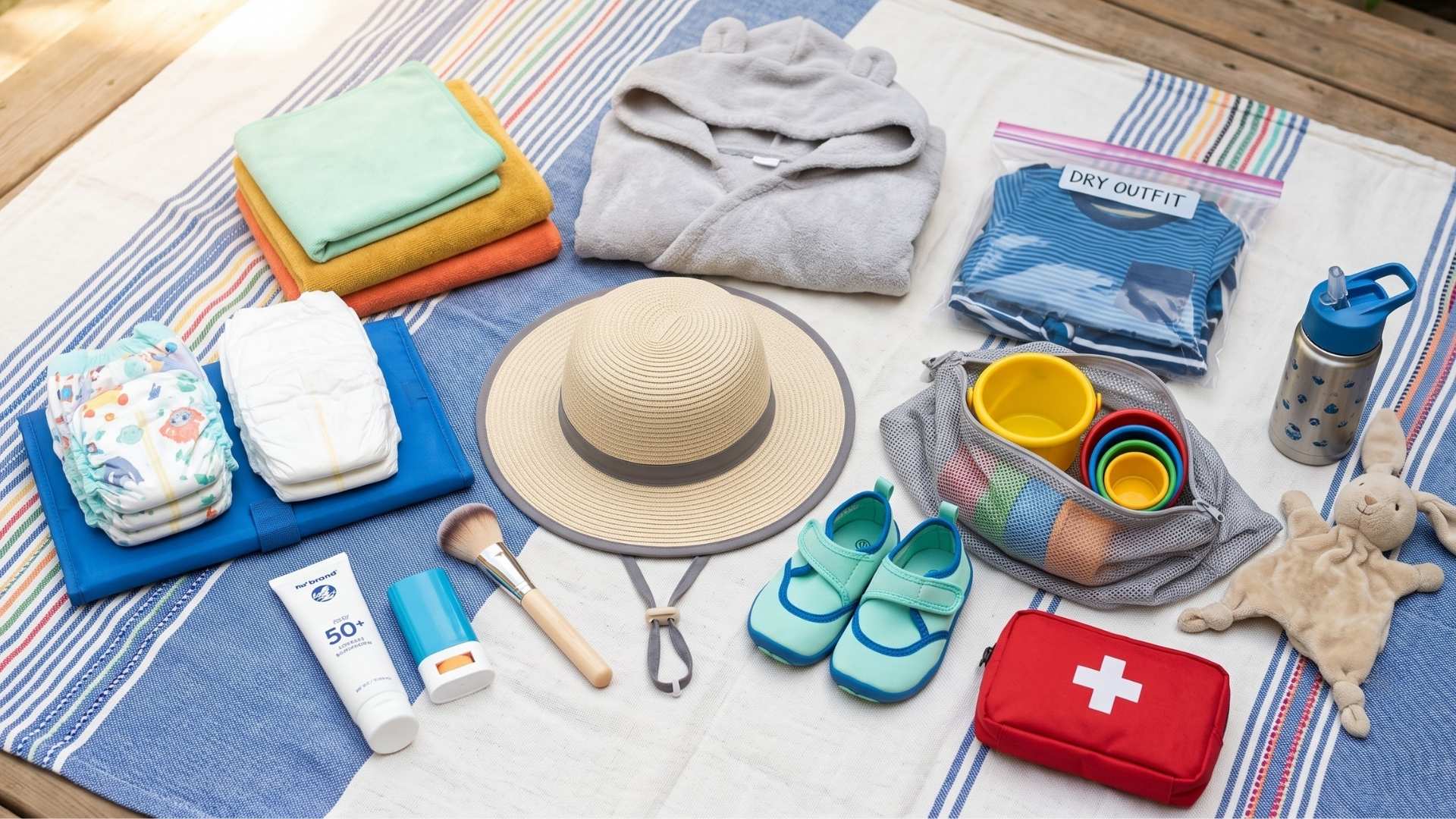
A toddler water day (beach, splash pad, waterpark, lake, or pool) packs differently from an older kid's. Toddlers need swim diapers plus regular diapers, water shoes ON before they leave the car, a full dry-clothes kit with dry underwear, snacks every 90 minutes, a comfort item, and a leaving strategy that starts 20 minutes before the meltdown. The visit runs shorter than you think. Plan for 90 minutes to two hours max.
Before you read on (a short note)
This is the toddler-specific packing guide. For the cross-destination pillar see family water day packing. For destination-specific master lists see the beach master packing list, the splash pad packing list, and the outdoor waterpark packing list. For under-1s see water day packing for a baby. For the safety arc see family water safety.
Why the toddler bag is heavier than any other age
A 4-year-old can wear a wet swimsuit for 20 minutes. A 7-year-old can wait to eat. A tween can navigate a lifeguard station. A toddler does none of those things. The toddler bag has to solve for a running body, a short attention span, a diaper situation, and a two-hour hunger window all at once.
"Toddlers need the most gear and the shortest clock."
The gear-to-visit-length ratio is the highest of any age. That sounds discouraging; it is not. Toddlers do genuinely well at water outings when the bag is right. The visit stays short, the gear covers the predictable problems, and the parent stays sane. What follows is the packing list built around that reality.
Realistic toddler water-outing lengths
- Splash pad: 60 to 90 minutes is the sweet spot for ages 1 to 3.
- Beach: 90 minutes to two hours before the first meltdown; longer is possible with a mid-visit nap in the shade tent.
- Waterpark: two to three hours max; the crowds and heat drain toddlers faster than the water features do.
- Pool: 45 minutes to an hour and a half; toddlers get cold faster than parents expect.
- Lake or river: 60 to 90 minutes for supervised shore play; add nap time in shade if you brought it.
Swim diapers, regular diapers, and the changing kit
Diapers are the single biggest gear category that separates a toddler bag from an older-kid bag. Bring more than you think, on the assumption that at least one of them will be a surprise.
Swim diapers
- Two to three swim diapers per outing. Splash pads and waterparks require them under specified ages or weights; check the venue's policy.
- Choose a fit that holds solids reliably. Disposable swim diapers do NOT hold urine (they are designed to; that is not a defect). Bring spares for the toddler who is toilet-training or between diapers.
- Reusable swim diapers work well for regular-splash-pad families. One reusable + one disposable backup per outing is a common setup.
- Change swim diapers OUT OF the water play area (bathroom, changing room, or car) to reduce risk of contamination for other families.
Regular diapers
- Four to six regular diapers for a half-day outing. Toddlers drink more water on hot days and go through diapers faster.
- Waterproof changing pad (the essential every non-parent thinks is optional).
- Wipes: bring a full pack, not a half-empty one.
- Diaper cream if your toddler is prone to rash.
- A wet bag or scented disposal bag for soiled diapers.
Potty-training toddlers
- A portable potty for beach days or long waterpark walks.
- Two full changes of clothes minimum (accidents happen at the least convenient moment).
- A calm plan for accidents: no big deal, quick change, back to fun.
- Extra swim diapers as a backup even for kids who are mostly trained.
Water clothing that stays on a running toddler
Toddlers move. Water clothing that fits well and stays put prevents the beach-blanket wardrobe crisis and keeps the sun protection in place.
Swimsuit
- Bright neon swimsuit (orange, pink, yellow) for crowd visibility. Skip blue and white; they blend into water.
- One-piece styles stay on better than two-pieces for the youngest toddlers.
- Backup swimsuit. Toddlers manage to soil, tear, or refuse the first one at least half the time.
- For splash pads: quick-dry shorts and a rash guard often work better than a swimsuit for kids who split time between water features and the playground.
Rash guard (the sun-protection MVP for toddlers)
- Long-sleeve UPF 50+ rash guard cuts the area you have to sunscreen by roughly half.
- Fits snug enough not to trip them; loose rash guards ride up and catch on water features.
- Bright color for visibility.
Sun hat with a chin strap (the hat WILL come off without one)
- Wide-brimmed for maximum face and neck coverage.
- Chin strap or toggle keeps it on in wind and when running.
- Backup hat. Toddlers throw them.
- Neck flap adds protection for beaches with strong sun.
Water shoes (this is where the toddler bag gets serious)
This category is the biggest single change from packing for an older kid. Toddlers do not tolerate hot sand, splash pad concrete, or waterpark pavement. They also lose flip-flops within 30 seconds of running.
- Fitted water shoes with secure heel straps. No flip-flops for water outings with under-3s.
- Sandal-style with adjustable Velcro closures. Closed-toe for rocky shores or hot pavement.
- Backup pair in the car for the ride home if the water shoes are soaked beyond wearing.
- For fit and selection see water shoes for kids.
Pro tip: water shoes ON before you leave the car
Put the water shoes on in the car before you get out. The parking lot at any water venue is hot pavement or sharp gravel. Toddlers in bare feet or flip-flops complain immediately, then refuse to walk, and you carry them plus the bag plus the towel plus the cooler. Water shoes on in the car eliminates the first meltdown of the day.
The dry-clothes kit (including the most-forgotten item)
Toddlers need a complete change ready for the moment you decide to leave. The moment usually comes suddenly.
What goes in the dry-clothes kit
- Full dry outfit per toddler: shirt, shorts or leggings, DRY UNDERWEAR (the single most-forgotten item), light hoodie.
- Backup outfit beyond the dry-clothes kit. Toddlers are creative about needing a second change.
- Light socks for the ride home if the shoes are damp.
- Hooded towel or towel-poncho (warms them faster, doubles as a cover-up for the walk to the car).
- Dry swim diaper or fresh regular diaper depending on the age.
Pro tip: one outfit per kid in a labeled zip bag
Pack each toddler's complete dry outfit in its own labeled zip-top bag: shirt, shorts, dry underwear, socks if needed, and a fresh diaper. Label the bag with the kid's name. After changing at the end of the visit, the wet swimsuit and any soiled items go back into the same bag. Saves the bottom of the beach bag from becoming a damp pile and prevents the swap-mix-up where the older kid ends up in the 2-year-old's shorts.
Sun protection for a squirming toddler
Toddlers are the worst customers for sunscreen application. They wiggle, they cry, they run. The workaround is a combination of tactics that reduce the surface area you need to cover and the drama at each application.
The sun protection layered kit
- Long-sleeve UPF 50+ rash guard (covers roughly half the skin you would otherwise sunscreen four times).
- Wide-brimmed sun hat with chin strap.
- Backup hat.
- Broad-spectrum mineral sunscreen, SPF 30 or higher, water-resistant. Zinc oxide or titanium dioxide.
- Sunscreen stick for face, ears, back of the neck, and part in the hair.
- A clean makeup foundation brush for face application (the calm-the-fight tool; see the tip below).
- Lip balm with SPF.
- Polarized sunglasses with a strap if your toddler will tolerate them.
Pro tip: the foundation brush for toddler face sunscreen
Keep a clean makeup foundation brush in the water-day bag year-round. Dab mineral sunscreen onto the brush and apply to the toddler's face like blush. The soft brush feels nothing like a parent's sticky hands. Toddlers who normally scream through sunscreen application often sit through this calmly. Also works for reapplications at the beach when their face is already sandy. Replace the brush once a season.
Sun protection timing rules
- First coat applied at home, on dry skin, before you leave.
- Reapply every 90 minutes from arrival.
- Reapply after every water session that lasted more than 20 minutes.
- Skip the direct-sun-then-application struggle: sunscreen while they are eating a snack.
Snacks and drinks (every 90 minutes, mostly hydrating)
Toddlers run out of fuel faster than the schedule expects. Skip the two-hour snack gap; you will pay for it in a meltdown 15 minutes before the timer said you would.
Water and drinks
- Toddler-sized insulated water bottle with a straw or spout. Toddlers drink more when the bottle is theirs.
- A second bottle in the car for refills.
- One frozen juice pouch or a few frozen grapes as a slushy midway treat.
- Optional electrolyte drink for very hot days.
Snacks that work for toddlers on water days
- Pouches: applesauce pouches, yogurt pouches, fruit pouches. No spills, no utensils.
- Grapes cut lengthwise for under-4s (whole grapes are choking hazards).
- Watermelon cubes, cucumber slices, orange segments in a hard-shell container.
- String cheese in a cooler bag.
- Crackers and rice cakes in a snap-top container.
- Pretzels in a snap-top cup.
- Small sandwiches cut in quarters (for a longer beach day).
- Puffs or O's cereal in a small container for the youngest toddlers.
What to skip as toddler snacks
- Whole grapes, hot dogs cut in coins, hard candies (choking hazards for under-4s).
- Chocolate and sticky bars (melt fast, sunscreen-glue combination).
- Anything that needs a utensil.
- Anything that has raw egg or mayo in a soft cooler.
- Foods your toddler has never tried before.
Comfort items and meltdown prevention
A toddler bag with just the physical essentials will still fail without the emotional-regulation gear.
What to bring for comfort
- The comfort object (favourite blanket, stuffed animal, silky, pacifier, chew) if your toddler has one and it is water-safe. Keep it in the bag as the emergency reset button.
- A backup comfort item if the primary one goes missing.
- One familiar snack the toddler always eats even when unhappy.
- One small quiet toy for the shade tent (small book, quiet fidget, small plastic animal).
- Sunglasses if they help the toddler tolerate glare.
The pre-visit briefing
The 30 seconds before you leave the car pays off. Say out loud: "We are going to the [venue]. First we set up our spot. Then we play in the water. When Mommy or Daddy says shoes on, we put shoes on and walk to the car for our special snack." Toddlers do better when they know the outline.
Pro tip: the this-is-our-spot home-base trick
As soon as you arrive at the beach, splash pad, or pool, walk your toddler to your chosen home base (blanket, umbrella, bench, stroller, or beach mat) and say: this is our spot. Point at it. Walk them back to it once. If they wander, redirect them to it. Not a supervision replacement, but it gives an anxious toddler a home base to find and helps them self-regulate in a busy environment. Combine with a bright ribbon or scarf on the umbrella or stroller so the spot is easy to see from a distance.
Stroller, wagon, or carrier: pick one
Toddlers walk between the parking lot and the water in theory. In practice, they walk 20 feet, then need to be carried, then need to walk again to see something interesting. The right transport choice makes this manageable.
Beach wagon (best for a long walk across sand)
- Wide balloon-tire wheels for soft sand.
- Room for the toddler on the way out, and again on the way back.
- Load with cooler, chairs, toys, bags on the way in.
- The transport solution that pays for itself by the second visit if you beach often.
Beach or all-terrain stroller (best for splash pads and waterparks)
- Sunshade attachment for the splash-pad-with-no-shade problem.
- Big canopy for naps at the beach.
- A place to keep the wet bag, phone, sunscreen, and hats within reach.
- Some waterparks require strollers to be parked in designated areas; check first.
Baby carrier or toddler carrier (best for lakes, rocky beaches, or beach walks)
- Hands-free for parents.
- Toddler stays close in busy or hazardous environments.
- Good for the tired-toddler moment when the stroller is at the car.
- Some carriers double as water carriers for shallow-water play; check the manufacturer guidance.
The two-adult carry alternative
If you are two adults and one toddler, you can carry the toddler between you and skip the wheeled option entirely. Adds calorie burn; saves storage space at home.
Water safety with a toddler (the rules scale down, not away)
Toddlers cannot swim reliably. Most water-safety incidents at family water outings involve toddlers who left an adult's line of sight for under a minute. For the full safety primer see our family water safety guide.
The five toddler-specific safety rules
- A US Coast Guard-approved life jacket sized to the toddler's weight (snug at shoulders and chest) for every non-swimmer AND for shallow water. Toddlers can drown in inches of water.
- Bright neon swimsuit and rash guard. Skip blue and white.
- One adult on water-watch at ALL times. Phone away, book down, no conversation that pulls eyes off the toddler. Trade shifts every 15 to 20 minutes.
- Arm's-length rule: within arm's reach for babies and toddlers under 2, within grabbing distance for 2s and 3s.
- Named meeting spot the moment you arrive. Take a photo of the toddler showing exactly what they are wearing today.
Specific toddler risks worth naming
- Wave pools can knock a toddler off their feet in inches of water. Adult in the wave pool with them, in the shallow end.
- Splash pad drains: teach the toddler not to sit on them; some suction-drain incidents have hurt small kids.
- Beach edges: the shore-to-water transition looks stable and is not. A toddler running toward the waves is the moment; adult next to them.
- Lake or river currents: even shallow rivers can pull a toddler off balance. Life jacket + arm's-length.
- Waterparks: strict height and weight rules for slides exist for a reason. Do not sneak the toddler onto a bigger-kid slide.
Inflatable arm bands, floats, and pool noodles
These are toys, not flotation devices. The AAP and the US Coast Guard agree. A USCG-approved life jacket is the only flotation device that meets safety-standard requirements for a non-swimming toddler. Keep floats and arm bands as fun accessories in the toddler pool where you are within arm's length; do not treat them as safety equipment.
The leaving strategy (starts 20 minutes before departure)
The end of a water outing is where toddlers reliably melt down. The prevention is a scripted transition that starts before the toddler is spent. For the full leaving-well approach across ages, see how to leave a water outing without a meltdown.
Pro tip: the 15-10-5-minute transition warnings
Toddlers cannot manage sudden endings. Start the wind-down 20 minutes before you want to be at the car. At the 15-minute mark say: fifteen minutes and then we dry off. At the 10-minute mark: ten minutes and then shoes on. At the 5-minute mark: five minutes and then we walk to the car for the special snack. Consistent, calm, boring. Some toddlers still push back at the transition, but the warnings prevent the ambush-meltdown that comes with a sudden let's-go.
The leaving sequence
- 20 minutes before departure: quiet announcement. Start packing non-essential items into the bag.
- 15 minutes: first warning. Move to shade for a snack.
- 10 minutes: second warning. Water shoes off (or on if going somewhere first), begin drying.
- 5 minutes: third warning. Dry clothes on, dry underwear check, water shoes back on for the walk.
- Departure: hand out the special car snack you saved. Toddler walks or rides in the wagon or stroller.
If the meltdown happens anyway
Some days the transition works; some days it does not. The plan is calm not perfect. Pick the toddler up, keep walking to the car, buckle them in, hand out the snack. Debrief with your partner or with yourself: what would we do differently next time? Do not blame yourself; toddlers are testing what limits look like. The visit still counts as a good one.
What to skip (the overpacking trap for toddler bags)
The toddler-bag temptation is to pack for every possible scenario. Do not. A bag that is too heavy to lift is a bag that stays in the car.
- Anything expensive or breakable.
- Multiple toys (bring one favourite, plus one backup). Toddlers pick up sand, sticks, shells, and lose interest in packed toys within 10 minutes.
- Elaborate meals. Snacks, a simple sandwich, fruit. Skip the picnic spread for a 90-minute visit.
- Screens and tablets. This is a water outing, not a car ride.
- Whole grapes, hot dogs in coins, hard candy (choking hazards).
- Complex outfits with buttons or ties. Toddlers cannot help you.
- Anything with metal grommets or hard buckles if you are heading to a waterpark (banned on body slides).
- Anything you cannot carry while also holding a toddler's hand.
- The kitchen sink. If you cannot answer "what specific toddler problem does this prevent," leave it in the car.
The complete toddler water day checklist (print or screenshot)
Use this as the final no-thinking-needed list. Categories match the sections above.
Diapers and changing kit
- Two to three swim diapers
- Four to six regular diapers
- Waterproof changing pad
- Full pack of wipes
- Diaper cream
- Wet bag or scented disposal bag
Water clothing
- Bright neon swimsuit
- Backup swimsuit
- Long-sleeve UPF rash guard
- Wide-brimmed sun hat with chin strap
- Backup hat
- Fitted water shoes with heel straps
- Backup water shoes or dry shoes for the ride home
Dry clothes kit
- Full dry outfit per toddler (shirt, shorts, DRY UNDERWEAR, light hoodie) in a labeled zip bag
- Backup dry outfit
- Socks
- Hooded towel or towel-poncho
- Fresh swim or regular diaper for after
Sun protection
- Broad-spectrum mineral sunscreen SPF 30+
- Sunscreen stick for faces
- Foundation brush for application
- Lip balm with SPF
- Toddler-sized sunglasses with strap (optional)
Snacks and drinks
- Toddler-sized insulated water bottle
- Backup bottle of water in the car
- Frozen juice pouches or frozen grapes
- Applesauce or fruit pouches
- Cut grapes, watermelon cubes, cucumber slices in hard containers
- String cheese in cooler bag
- Crackers, pretzels in snap-top cups
- Small sandwiches for longer visits
- One familiar snack the toddler always eats
Comfort and meltdown prevention
- Primary comfort object
- Backup comfort item
- One small quiet toy for the shade tent
- Pre-visit briefing done in the car
Transport
- Beach wagon OR beach stroller OR baby/toddler carrier (pick one for the day)
- Clip-on stroller shade
- Bag hooks for stroller
Safety
- US Coast Guard-approved life jacket sized to the toddler's weight
- Bright neon swimsuit (also above)
- Waterproof ID bracelet or phone-number card in the toddler's bag
- Photo of the toddler taken at start of day
- First-aid kit (waterproof bandages, wipes, tweezers, medications)
Parent essentials
- Phone in waterproof pouch on lanyard
- Keys, wallet, ID, payment card
- Dry shirt for parent (toddler-hug defense)
- Foldable lawn chair or backpack chair
Frequently asked questions
How long should a water outing with a toddler last?
60 to 90 minutes at a splash pad, 90 minutes to two hours at the beach, two to three hours max at an outdoor waterpark. Toddlers get cold and tired faster than parents expect, especially in the pool. Plan for the shorter end of these windows and stay longer if the toddler is genuinely happy, but do not push past the meltdown window.
What is the most important thing to pack for a toddler water day?
Fitted water shoes with heel straps, put on in the car before you get out. Beyond that, swim diapers plus regular diapers (spares of both), a full dry-clothes kit with dry underwear, a hooded towel, a comfort object, mineral sunscreen with a foundation brush for application, snacks every 90 minutes, and a bright neon swimsuit for visibility.
How many diapers should I bring for a toddler at a water outing?
Two to three swim diapers plus four to six regular diapers for a half-day outing. Toddlers drink more water on hot days and go through diapers faster than a normal day at home. Swim diapers do not absorb urine (that is by design; they only contain solids), so having spare regular diapers ready is critical for potty-training toddlers or the between-diapers age.
Do toddlers need water shoes at the splash pad, beach, or waterpark?
Yes, strongly. Fitted water shoes with heel straps protect toddlers from hot pavement, hot sand, sharp rocks, and slippery concrete. Flip-flops slip off toddlers within 30 seconds of running. Put the water shoes on in the car before you get out; the parking lot itself is hot pavement at any water venue.
What sunscreen is safest for a toddler at the beach or pool?
A broad-spectrum mineral sunscreen with zinc oxide or titanium dioxide, SPF 30 or higher, water-resistant. Apply the first coat at home on dry skin before you leave; reapply every 90 minutes from arrival and after every 20-plus-minute water session. Use a clean makeup foundation brush for face application; toddlers who fight the hand-rub-on often sit through the brush calmly.
Do toddlers need life jackets even in shallow water?
Yes for any body of water where they cannot reliably stand and breathe. Toddlers can drown in inches of water. A US Coast Guard-approved life jacket sized to the toddler's weight, snug at shoulders and chest, is the only flotation that meets safety-standard requirements. Inflatable arm bands, pool noodles, and floats are toys, not flotation devices; both the AAP and the US Coast Guard agree on this.
What snacks work best for a toddler at a water outing?
Pouches (applesauce, yogurt, fruit) with no utensils, no spills. Grapes cut lengthwise for under-4s. Watermelon cubes, cucumber slices, orange segments in hard containers. String cheese in a cooler bag. Crackers in snap-top cups. Frozen juice pouches or frozen grapes for the slushy midway treat. Skip whole grapes, hot dog coins, and hard candy (choking hazards under 4).
How do I prevent a meltdown at the end of a toddler water day?
Start the leaving process 20 minutes before you actually leave. Give 15-10-5-minute warnings: fifteen and we dry off, ten and shoes on, five and we walk to the car for the special snack. Save one specific snack that only comes out at the car. Some toddlers still push back; the warnings prevent the ambush-meltdown, which is the worst version. The visit still counts as a good one even if the leaving is bumpy.
Stroller, wagon, or carrier for a toddler water day?
Beach wagon with balloon tires for beach days (holds the gear on the way in, holds a tired toddler on the way back). Beach or all-terrain stroller with sunshade for splash pads and waterparks. Baby or toddler carrier for lakes, rocky beaches, or beach walks where you want the toddler close. Pick one for the day; do not try to bring two.