
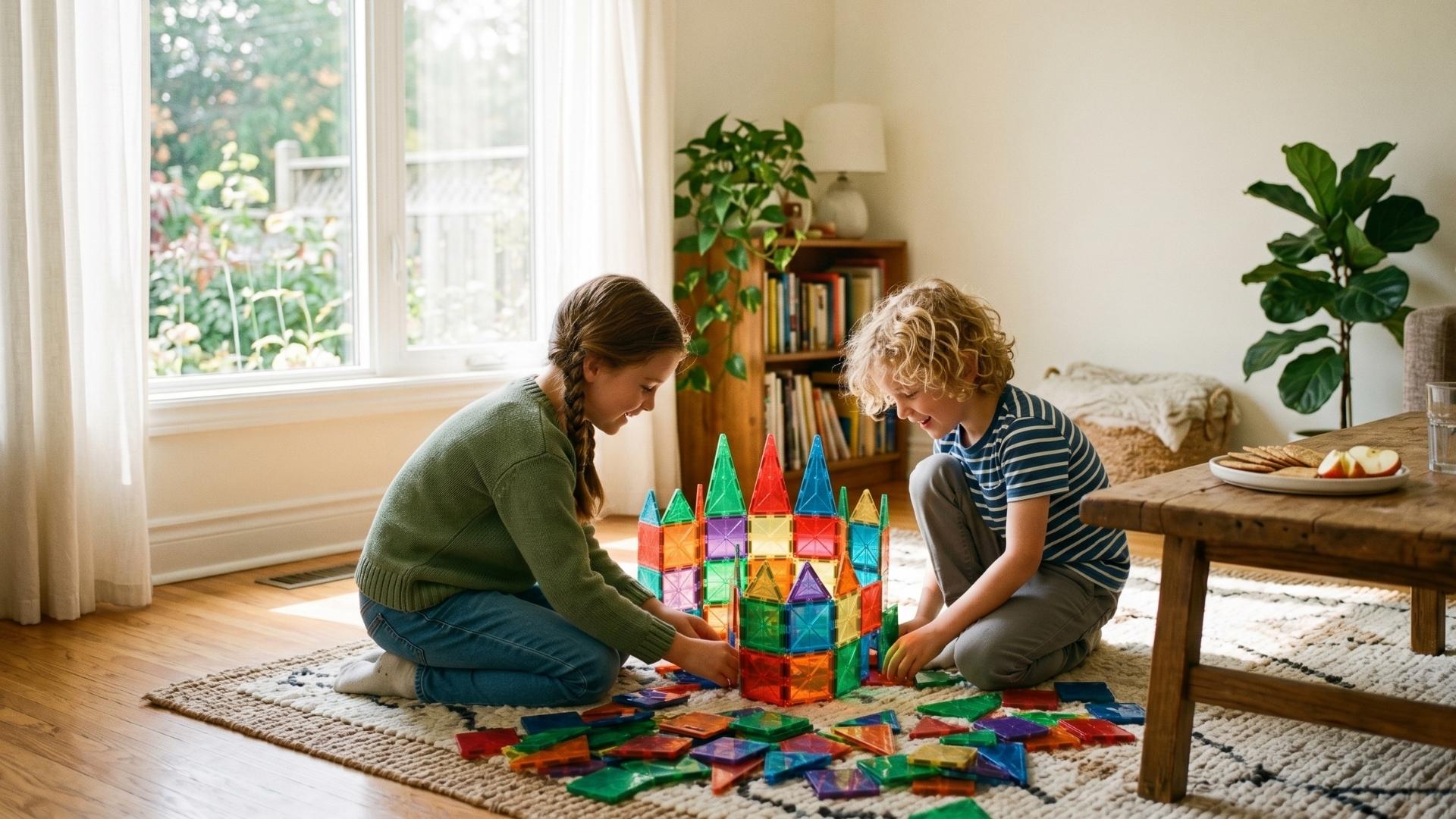
A screen-free playdate is not about being puritanical; it is about giving the kids a clear runway to find their own play. Most kids fall into a great hour of pretend or building once the screen is off the table, but the first 10 minutes can be tough. Here is how to set one up so it works, including the small conversation with the other parent that makes the difference.
Why screen-free playdates are worth the setup
Screen play and peer play are different activities, even when both kids are sitting next to each other. Two kids on a tablet are mostly absorbed in the screen; two kids in a pretend game are absorbed in each other. Both have their place. The point of a playdate, though, is the second kind.
The AAP guidance on family media use is matter-of-fact about screens: they are not the enemy, but they should not crowd out unstructured social play. A screen-free playdate is not a moral position; it is a deliberate choice to protect the play time.
If you are still working out the broader playdate logistics, our complete guide to playdates covers the bigger picture. This piece is the screen-free question.
The conversation with the other parent (so it does not feel weird)
If you are hosting and you would prefer no screens, say so in the setup text. Most parents are fine with it; many will be relieved.
A script that lands well: "Heads up, we usually do screen-free at playdates, just so it is easier to keep them playing together. Happy to swap if your kid usually relies on a tablet for any specific reason."
The escape hatch matters. Some kids genuinely use screens for self-regulation (autism, sensory needs, anxiety). The script above gives the visiting parent room to flag that without it being a thing.
If you are visiting and the host has a screen-light policy, do not bring a tablet "just in case." If you are visiting and the host's home leans heavy-screen, you can ask: "We are trying to do less screen time, would it be okay to skip the iPad part of the visit?" Most hosts will accommodate.
What to do in the first 10 minutes (the hardest stretch)
The first 10 minutes are when a kid will ask for a screen. The fix is to have one, simple, parallel activity ready before they arrive, so the question never comes up.
Best openers: snack at the table (universally accepted starter), a building activity already set out on a rug, a puzzle on the kitchen table, a basket of dress-up clothes laid out in the play area. The point is that they walk in and find something to do, not that they walk in and look at each other.
Avoid: announcing the no-screen policy on arrival. Do not start with "so we are not doing screens today." Start with "hey, glad you are here, the snack is on the table." Lead with what you are doing, not what you are not doing.
15 screen-free playdate activities that actually work
Sorted from low-prep to higher-prep. Pick one or two; you do not need a full programme.
- Indoor fort with books inside.
- Sidewalk chalk on the driveway.
- Dress-up box plus a pretend-play prompt ("you are running a restaurant").
- Building set: magnatiles, LEGO, wooden blocks, a build challenge.
- Pretend cooking with playdough.
- Backyard scavenger hunt.
- Hide-and-seek with stuffed animals as the hiders.
- Kitchen science: oil and water, baking soda and vinegar, food colouring drops.
- Ice cube painting outside on the path.
- Simple cooking project: pizza, pancakes, decorating cookies.
- Park visit with a frisbee or soccer ball.
- Library visit, stay 45 minutes, browse and read.
- Walk to a coffee shop with their own colouring books and pencils.
- Stop-motion film with toys (yes, this uses a phone, but the kids are creating, not consuming).
- Paint, draw, or do collage on a long roll of butcher paper across the kitchen floor.
If the day is wet, our rainy day playdate ideas has more indoor options. If the weather is good, our outdoor playdate ideas has the outside list.
Screen-free by age
Toddlers (1 to 3)
Easy. Toddlers do not really need screens at playdates and most do better without them. A sensory bin, a few wooden toys, and another small kid is the entire playdate plan.
Preschoolers (3 to 5)
Mostly easy. Preschoolers are deep into pretend play, which does not translate well to screens anyway. Stage one pretend prompt (a play-kitchen, a dress-up box, a small-world setup with toy animals) and they will go for an hour without thinking about an iPad.
Early school-age (5 to 8)
Sometimes harder. Some 6 and 7 year olds genuinely default to a screen at home and need a slightly more interesting alternative on a screen-free playdate. Build challenges, baking projects, and active games (treasure hunts, indoor obstacle courses) work best.
School-age and tweens (8 to 12)
The hardest stretch. Many tweens use phones and games as their primary social mode and a fully screen-free hangout can feel forced. The middle-ground option: phones in a bowl by the door for the first 90 minutes, then optional shared screen time at the end (a video together, a co-op game, a YouTube category they like). Full screen-free is doable for younger kids in this band; for 11 to 12, the bowl-by-the-door version often lands better.
When screens are actually fine during a playdate
Screens are not the enemy. There are situations where one short, intentional screen window is the right call.
- End-of-playdate wind-down. A 20-minute episode of something familiar while the kids transition from active play to pickup.
- Co-watching, not solo-watching. Two kids watching the same film on the couch is closer to social activity than two kids each on their own tablet.
- Creative or shared use: a stop-motion film, taking photos around the house with a camera app, building together in Minecraft or Roblox in the same room.
- Sensory or anxiety regulation. Some kids genuinely need a screen window to reset; the playdate is not the moment to test that.
- Long playdates that span dinner. A film at the end while the parents make food is a fine landing pattern.
What is less ideal: silent solo-screen time across a whole playdate, autoplay YouTube on tablets without a parent in the loop, or video games that are violent or rated above the younger kid in the room. Common Sense Media is the most reliable source for film, app, and game age ratings if you are unsure.
How to handle complaints (yours and theirs)
Sometimes the kids will whine about the no-screen rule. Sometimes you will start to wobble around minute 75 because the energy is loud and a screen would buy you 30 minutes.
What helps: a short, clear answer the first time. "We are not doing screens this playdate, you can have one later when you are home. Here is the LEGO basket." Said matter-of-factly, not defensively. Most kids accept the second version of "no" even if they did not love the first.
If you are wobbling: take it as a signal that the energy needs to shift, not that the screen needs to come on. A snack break, a movement burst, or a switch to a quieter activity will reset the playdate. Often a 10-minute walk around the block fixes what a screen would have papered over.
What about board games and card games?
Board games are excellent screen-free playdate fuel and underused, especially for the 6-to-12 set. They give a structured social activity, force conversation and turn-taking, and absorb 30 to 60 minutes reliably.
Best playdate-friendly games by age: Spot It, Sleeping Queens, Sushi Go (ages 6+); Ticket to Ride, Catan Junior, Codenames Pictures (8+); Settlers of Catan, Wingspan, Codenames (10+). For younger kids: a simple puzzle, Memory, dominoes, Uno.
Two practical rules. First, pick a game shorter than the playdate window; a 90-minute Catan game can blow up a 2-hour playdate. Second, decide upfront if you are playing for fun or playing for the win; some kids genuinely struggle with losing in front of a friend.
What about tweens, who basically live on their phones?
Be realistic. A 12 year old whose social life happens on Discord, Snapchat, and group chats may experience a fully screen-free playdate as a forced family-time event, not a hangout. Expectations matter.
Two formats that work for the older end. First: phones-in-the-bowl for the first 90 minutes (most tweens will go along with this when it is the house rule, especially if there is food and an interesting activity). Second: a shared activity that uses screens but is genuinely social (co-op video games on a console, a movie they actually want to watch together, photo editing or making a TikTok for fun, building in Minecraft together).
The wider conversation about phones and tweens is worth its own piece, and our guide on tween playdates has more on what makes a hangout work for this age. The headline: do not fight the phone, but make the offline option more interesting than the phone.
Frequently asked questions
How do I tell another parent we are doing a screen-free playdate?
Mention it in the setup text, not on arrival. "Heads up, we keep playdates screen-free, just so the kids stick to playing together, happy to chat if that is a problem." Most parents will not flinch; some will be glad. Lead with the practical reason, not a values statement, so it does not sound like a lecture.
What if my kid throws a tantrum about no screen?
Hold the line for the first time, then redirect to a clear alternative. "No screens at this playdate, here is the LEGO bin." Most kids reset within five minutes once they realise the answer is final. If your kid genuinely cannot regulate without a screen, that is worth noticing outside the playdate (and worth discussing with their paediatrician if it is a pattern).
Are board games a good substitute for screens at playdates?
Yes, especially for ages 6 and up. A 30-minute game absorbs the same energy a screen would, and it produces conversation and turn-taking instead of parallel watching. Choose a game shorter than the playdate window and avoid heavy-strategy games for kids who get visibly upset about losing in front of a friend.
Are there any kids for whom a fully screen-free playdate is a bad idea?
Yes, sometimes. Some kids with autism, ADHD, or sensory regulation differences use a screen as a co-regulation tool, and removing it cold for a 2-hour playdate can spike anxiety. The fix is not no-screens-ever, it is a brief screen window planned in advance, often at the end. Talk to the visiting parent in advance if you are unsure.
Is co-watching or shared video games actually screen-free in spirit?
It is a halfway house. Co-watching is more social than solo-watching, and a shared video game is closer to a board game in structure. Neither is the same as pretend or building, but both are real social play. A reasonable compromise: skew most of the playdate toward off-screen activity, allow a short shared-screen window at the end if you want.
How long can a screen-free playdate be before it gets stale?
About 2 to 2.5 hours for school-age kids, with one snack break in the middle. Past that, both kids start to fade and the no-screen rule becomes a battle rather than a backdrop. Wrap before the meltdown; a great 90-minute screen-free playdate is better than a 3-hour one that ends with both kids glued to a tablet anyway.