
Rainy day playdates fail when you try to recreate the magazine version of "cosy indoor afternoon." They work when you accept the truth: kids need to move, the floor will get messy, and one strong activity will outperform a basket of half-considered crafts. Here are 25 ideas that survive the first 15 minutes, sorted by age and prep, with notes on when it is okay to put on a movie.
What actually makes a rainy day playdate work
Three things. A space the kids can actually move in (push back the coffee table, clear a corner). One starter activity staged before they arrive. And a willingness to swap activities every 30 to 45 minutes; rainy day attention spans are shorter than outdoor ones because the body has nowhere to discharge energy.
What does not work: handing a kid a craft kit and saying "do this for two hours." Crafts work for 20 minutes, max, before the kids want the next thing. Plan a rotation, not a project.
If you are still working out the broader playdate logistics, our complete guide to playdates covers the bigger picture. This piece is the rainy-day idea bank.
10 zero-prep ideas (open and go)
These need nothing more than what is already in your house.
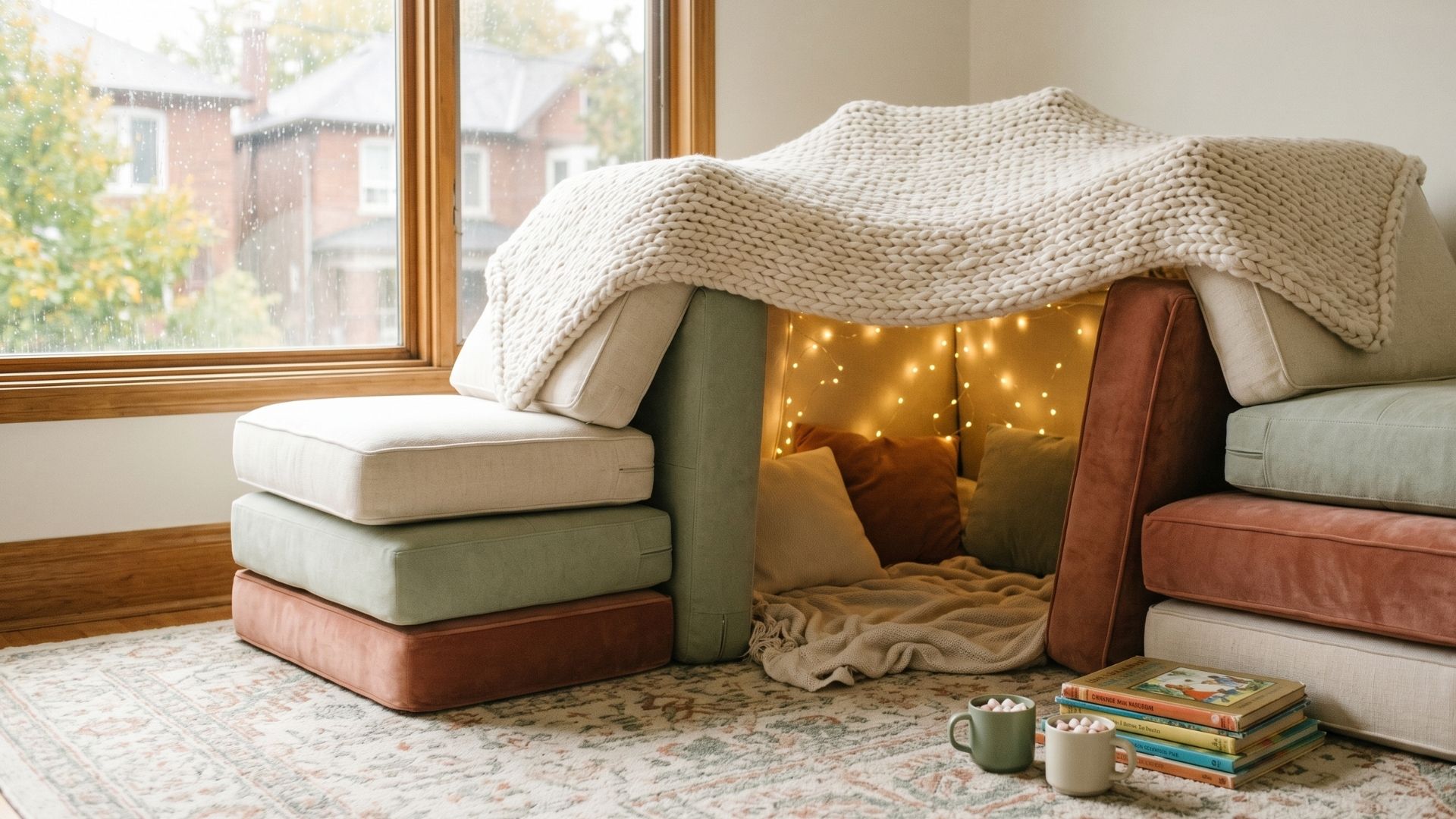
- Indoor fort. Couch cushions, dining chairs, a sheet, a string of lights if you are feeling fancy. Easily 45 minutes of building plus another 30 of playing inside.
- Hide and seek with extreme rules. Closet only, whisper-volume, plush toy hiding instead of kids. New rules turn an old game into a new one.
- The floor is lava. Pillows on the floor, no foot may touch the carpet for 10 minutes. Add a mission (rescue the dog from the kitchen) for older kids.
- Living-room dance party. Make a 30-minute playlist of songs the kids actually like. Lights low, curtains closed.
- Indoor scavenger hunt. Write a list of 10 things to find around the house: something blue, something soft, a book with an animal on the cover, a crayon under the couch.
- Stuffed animal hospital. Bandages, a clipboard, a stethoscope if you have one. Each kid runs intake and triage on the patients.
- Reading fort. Pile of books, blanket, two flashlights, and one rule: quiet for 20 minutes. Best deployed when the energy is too high.
- Sock match races. Dump the clean laundry pile on the floor, two kids race to match the most pairs in 5 minutes. You also get folded laundry.
- Charades or freeze-dance, depending on age. Both work down to about age four.
- Couch construction site. Couch cushions become a slide, a tunnel, a wall to knock down, a stage. Adults stay nearby to spot. Free and reliable.
10 light-prep ideas (under 5 minutes of setup)
Worth the small effort.
- Tape-line obstacle course. Painters' tape on the hallway floor: hopscotch, balance beams, jump zones. Done in 4 minutes, kids run it for 30.
- Ice cube painting. Freeze a tray of water with food coloring and a popsicle stick. Paint on white paper. Cleanup is mostly water.
- Salt dough or playdough. Flour, salt, water, cream of tartar (if you have it), oil. Three minutes to make, an hour to play with.
- Cardboard box anything. The biggest box you have plus markers, scissors (adult-supervised), and washi tape. Becomes a robot, a car, a fort, a puppet theatre.
- Kitchen science: oil and water in a clear glass, food coloring drops, watch what happens. Baking soda and vinegar in a bowl. Foam, fizz, child delight.
- Sensory bin. Rice or dried pasta in a deep tray, plus measuring cups, scoops, small toys. Excellent for under-fives. Vacuum after.
- Bake one thing. Banana bread, cookies, pancakes. Pick something with five ingredients and 25 minutes of baking. Kids do the measuring; you do the oven.
- Indoor bowling. Empty plastic bottles or paper cups as pins, soft ball, hallway. Score on a notepad.
- Magnetic-tile or LEGO build challenge. Set a brief: build the tallest tower, build a bridge that holds a teddy bear, build a house for a toy car.
- Music-and-instrument jam. Pots and pans, wooden spoons, a tambourine if you have one. Loud, brief, satisfying.
5 longer-engagement ideas for the 90-minute window
When you need one activity that lasts a real chunk of time.
- A real cooking project. Pizza-from-scratch, sushi-rolling with cucumber and avocado, decorating their own cookies. Forty-five minutes plus a snack at the end.
- Stop-motion animation. A phone, a free stop-motion app, a toy and some clay. Ten minutes of teaching, then they will do an hour without looking up.
- Living-room theatre. Pick a fairy tale, write a five-minute version of it, costume it from the dress-up box, perform for the parents. Goes long if both kids are into it.
- Build-a-zoo or build-a-village. Empty a bin of small toys onto the rug and let the kids build a habitat or town across the floor. Add small mirrors as ponds and toilet paper rolls as trees.
- A long-form drawing project. Tape a roll of butcher paper across the kitchen floor, give them every marker you own, and let them collaborate on one giant drawing of their world.
If the rainy day is also low-energy and you want a slower vibe, our piece on screen-free playdates has more on activities that calm rather than rev.
Rainy day ideas by age
Toddlers (1 to 3)
Sensory bin (rice or dried pasta), water play in the kitchen sink with cups and pots, a fort with a board book inside, a bowl of cooked spaghetti to squish. Toddlers do not need 25 ideas; they need one bin and a snack.
Preschoolers (3 to 5)
Playdough, dress-up, indoor fort, hide-and-seek, and a baking project. This is the age where pretend play takes off, so dress-up plus a story prompt ("you are a vet, the bear is sick") will go long.
Early school-age (5 to 8)
Tape obstacle course, kitchen science, building challenges with magnatiles or LEGO, stop-motion, baking. This age wants a small challenge with a clear goal.
School-age and tweens (8 to 12)
Cooking projects, board games, stop-motion, art projects with real materials (acrylic paint on canvas, clay, sewing), a basement or living-room sleepover-style hangout with snacks and a movie at the end. Tweens want autonomy; offer the materials and walk away.
When (and how) to put on a screen
Sometimes the rain wins, the energy is low, and the kids just want to flop on the couch with a film. That is okay; one screen window during a playdate is not a moral failure.
The AAP guidance on family media use is matter-of-fact about this: what matters is not zero screen time, it is the role screens play in the day. A 45-minute movie at the end of a 2.5-hour playdate is part of a balanced afternoon. A 2.5-hour movie that is the whole playdate is a different thing.
If you do screens, do them at the end. Activity first, when energy is fresh; screens last, when they are winding down. The reverse pattern (screens first, activity later) almost never produces a kid who wants to switch off and play.
For age-appropriate film picks, Common Sense Media is the most reliable source for age ratings, what is in the film, and what the discussion-with-your-kid points might be.
What to do when bodies need to move (and you cannot go outside)
By minute 60, kids who have been indoors all day will be vibrating. Plan a movement block.
Options that work in a small flat: living-room yoga (free kid-yoga videos abound), 10 minutes of jumping jacks and animal walks (bear walk, crab walk, frog jump), a one-song dance break every 30 minutes, a hallway race (back and forth, fastest, slowest, walking backward, on tiptoe). The point is a sweat break, not a workout.
If you have stairs, a stair-running interval (up, down, up, down for two minutes) is the closest thing to a park that an apartment can offer. Do not skip the movement block; the playdate ends in tears without it.
Snacks that work on a rainy day
Same rules as any playdate: simple, familiar, low-mess. Apple slices, crackers and cheese, halved grapes, a small bowl of pretzels. The only twist for a rainy day is that snack also doubles as the activity-pivot moment: "Snack break, then we'll do the obstacle course."
Hot snack option: 4-minute mug pancakes, microwave popcorn (over fives), or melted cheese on a tortilla. Warm food on a grey day is its own small joy and the kids notice.
Full snack guide in our 30 best playdate snacks article, including allergy-friendly swaps.
When to break the rules and go outside anyway
Sometimes the right answer to "it is raining" is to put on the wellies, hand each kid an umbrella, and go out for 30 minutes. Splashing in puddles, jumping over leaf piles, and walking in the rain to a coffee shop for a hot chocolate are some of the best playdate memories most kids will have.
The one-line script for the other parent: "We have spare wellies and rain jackets, we are thinking of doing a 30-minute splash walk and then back for hot chocolate, would she be up for it?" Most parents will say yes.
More on the wider outdoor argument in our piece on outdoor playdate ideas. The short version: cold and wet is rarely a real reason not to go out; the right gear is.
Frequently asked questions
What can I do with two preschoolers indoors for two hours?
Plan a rotation, not a single activity. A typical winning sequence: 30 minutes of fort building, 15 minutes of snack at the kitchen table, 30 minutes of dress-up or pretend play, 15 minutes of music and dance, 20 minutes of a calm activity (drawing, reading) before pickup. Two hours, four activities, zero meltdowns.
Are screens okay during a rainy day playdate?
A short, intentional screen window at the end of the playdate is fine. A short film, an episode of something familiar, or a co-watched YouTube category they like. What is less ideal is screens as the whole playdate; the social-skills development you want from a playdate happens during the play, not the watching.
What is a good rainy day idea for kids who do not get along well?
Choose parallel activities, not collaborative ones. Two kids drawing the same picture together is harder than two kids each making their own picture at the same table. Reduce the friction surface. Building, drawing, and baking (with clear separate tasks) all work; competitive games and shared-toy play are higher-friction.
What if I have nothing in the house and no time to prep?
Indoor fort, hide and seek, and a snack will fill 90 minutes by themselves. Add a 20-minute family-room dance party and a short film at the end and you have a complete playdate without buying or cooking anything.
How long should a rainy day playdate be?
Slightly shorter than a normal one. Indoor playdates run hotter; aim for 1.5 to 2 hours rather than 2.5 to 3. Plan a sharper end. Watching for the second-wind crash around the 90-minute mark and wrapping up before the meltdown is the key skill.
Are craft kits worth it for a playdate?
For a one-off, yes, especially if it includes a finished project that the kids take home. For regular use, no; loose-parts crafts (paper, glue, scissors, washi tape, cardboard) almost always go further than a kit. The kit produces the same result for every kid; the loose materials produce something the kid actually invented.