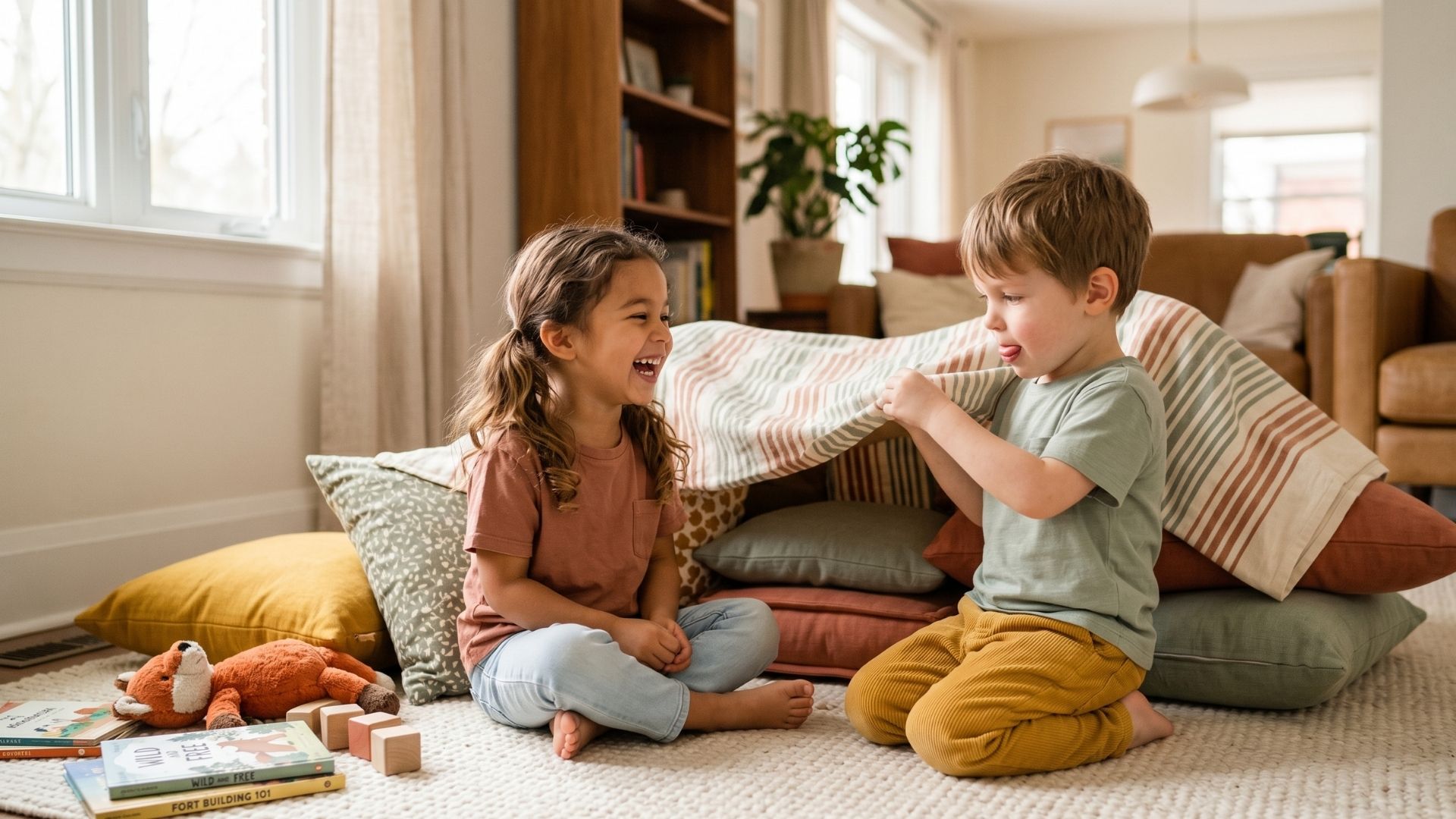
A playdate is planned time for kids to play together, usually arranged by parents. Most kids ages 3 to 8 do best with one or two playdates per week. Toddlers may only need one. Tweens often prefer fewer, longer hangouts. This guide covers everything: when to start, how often, how to host, what to do during one, and how to handle the snags that come with all of it.
What counts as a playdate, and when do they start?
A playdate is planned, parent-arranged time for one child to play with one or two others. Preschool, daycare, and group classes do not count. Those are professional caregivers managing a group. A playdate is the social equivalent of a coffee date: deliberate, scheduled, and chosen.
Most kids start having recognizable playdates around 18 to 24 months, though some families start earlier. At that age, do not expect cooperative play. Toddlers do parallel play: they sit near each other, do similar things, and occasionally trade toys or screams. That is normal and developmentally healthy. According to Zero to Three, the ability to truly play together with a peer typically emerges around age 3.
Real cooperative play (sharing a game, taking turns, building something together) usually shows up between ages 3 and 4. By kindergarten, kids start picking their own friends and asking for specific kids by name. By age 7 or 8, the social side of playdates often matters more than the activity itself.
If you want age-specific activity ideas, see our guides for toddlers (ages 1 to 3), preschoolers (ages 3 to 5), school-age kids (ages 6 to 9), and tweens (ages 10 to 12).
How often should kids have playdates?
Most kids do best with one or two playdates per week. The exact number shifts with age.
- Toddlers (ages 1 to 3): one playdate per week is plenty. They get social input from caregivers and siblings, and they tire fast.
- Preschoolers (ages 3 to 5): one to two per week. This is when friendships start to take real shape.
- School-age (ages 6 to 9): two to three per week, including the casual after-school kind.
- Tweens (ages 10 to 12): often one or two longer hangouts. Quality over quantity.
Frequency matters less than consistency. A 5-year-old who plays with the same friend twice a week tends to form a stronger bond than one who rotates through five different kids once a month. The American Academy of Pediatrics emphasizes that consistent peer relationships in early childhood support social-emotional development. You can read their full guidance at HealthyChildren.org.
Signs your kid might need more playdates: lots of clinginess to you on weekends, asking constantly about specific friends, struggles with peer interactions at school. Signs they might have too many: meltdowns after almost every social event, persistent exhaustion, dread the morning of.
For a deeper breakdown by age, see our guide on how often kids should have playdates.
How long should a playdate last?
The right length depends on age. Going too long is the most common mistake new hosts make.
- Toddlers: 60 to 90 minutes. After 90 minutes, someone is usually melting down.
- Preschoolers: 90 minutes to 2 hours.
- School-age: 2 to 4 hours.
- Tweens: half a day or longer. They will tell you when they are done.
Set a timer mentally before the playdate even starts. End it while everyone is still having fun, not after the wheels have come off. Ending early on a high note is what makes a kid ask for a repeat.
More on this in our breakdown of how long a playdate should last by age.
How to set up your first playdate
The hardest part of playdates is asking. Most parents want to host or be hosted but freeze on the invitation step. You being the one to suggest it is a gift, not an imposition.
Where to find playdate friends
- Your child's preschool, daycare, or classroom
- Library story times and community-center programs
- Recurring classes (gymnastics, music, art, swim)
- The same park at the same time each week (the regulars become friends)
- Your neighborhood (the family across the street with kids the same age)
The ask itself
Keep it short and concrete. "My daughter has been asking about Mia. Would you two be free Saturday morning around 10 for a park hangout?" Specific time, specific place, low-stakes setting. The park works because nobody has to clean their house.
If they say no, do not assume rejection. Most no's are scheduling. Try again in a week or two.
Where to do the first one
A park is almost always the right answer for a first playdate. It is free, low-pressure, and naturally bounded. If your child is between 3 and 7, plan for 60 to 90 minutes. Bring water and a snack. End it before someone is hungry or tired.
For more on this, see how to set up your first playdate, how to ask another parent without being awkward, and where to find playdate friends.
Hosting at home: what actually works
Hosting feels harder than it is. The basics: confirm timing the day before, ask about allergies and food restrictions, do a quick safety sweep, plan one or two activities, and be ready to abandon those plans if the kids find their own thing.
Before they arrive
- Text the other parent the morning of: "Still on for 10? Anything I should know about food or allergies?"
- Walk through the rooms the kids will use. Pick up anything breakable, dangerous, or precious to your kid (the toy they will not share).
- Have a snack ready (cut fruit, crackers and cheese, water) for about 30 minutes in.
- Pick one or two activities you can break out if energy flags. You will not need them most of the time.
What to actually do during the playdate
Mostly: nothing. The best playdates are the ones where the kids invent their own thing and you stay out of the way. Have backup activities ready, but resist the urge to direct. Adults running playdates like camp counselors is a recipe for burnout (yours and theirs).
House rules to mention
Brief and friendly: "We don't go upstairs without an adult," "the dog stays in the kitchen," "shoes off in the play area." Tell them once. Move on. Visiting kids absorb rules faster than you think.
Wrapping up
Give a 15-minute warning, then a 5-minute one. Have the kids do a quick group cleanup, even a token one. Walk the guest to the door with their stuff already in hand. The handoff back to their parent is smoother if nothing has to be hunted down.
For more, see how to host a successful playdate at home, playdate snack ideas, the playdate allergies guide, and our childproofing checklist.
The etiquette every parent should know
Playdate etiquette is mostly common sense applied to a setting where everyone feels slightly off-balance. The shorthand: be on time, be honest about food and rules, and assume the other parent is doing their best.
If you are hosting
- Confirm the day before. Cancellations happen, and a same-morning text avoids surprises.
- Feed the kids. Even a simple snack signals you take the visit seriously.
- Watch the time. End when you said you would, not 45 minutes later.
- Send the kid home reasonably tidy. A quick wipe of the face if there was paint or popsicles.
- If something happened (a meltdown, a small injury, a broken toy), tell the other parent at pickup. Owning it once is much easier than them finding out later.
If you are the guest
- Arrive on time. Not 20 minutes early, not 30 minutes late.
- Ask about house rules when you arrive. Screens, snacks, shoes, anything specific.
- If your kid is having a hard moment, step in. Do not leave it for the host.
- Help with cleanup before you leave. Five minutes of tidying goes a long way.
- Reciprocate within a month. The next playdate at your place keeps the friendship balanced.
- Send a quick text afterward. "Thanks for hosting, kids had a blast" is enough.
More detail in our guides on playdate etiquette, host etiquette, and guest etiquette.
Activities by age (a quick map)
What works at a playdate depends almost entirely on age. Here is the rough map. Skip ahead to your kid's stage.
Toddlers (ages 1 to 3)
Sensory bins, water play, music and movement, simple puppets, picture books. Parallel play is the goal, not cooperation. Keep playdates short and adult-supervised. Skip anything with small parts and anything that takes more than five minutes of patience.
Preschoolers (ages 3 to 5)
Pretend play setups (kitchen, doctor, store), dress-up, simple crafts (sticker books, playdough), cooperative games like Memory or Snail's Pace Race. Outdoor: chalk, bubbles, ride-on toys, sand. This is the age when a single great prop (a refrigerator box, a basket of scarves) can carry a whole playdate.
School-age (ages 6 to 9)
Project-based playdates work well: building a fort, baking cookies, doing a science experiment, making a stop-motion video. Board games, card games, and outdoor adventures all hit. Step back and let them run their own play.
Tweens (ages 10 to 12)
By this age, playdates morph into hangouts. Cooking together, doing a craft project, playing a video game, going to a movie or trampoline park. Screens often factor in. Set expectations in advance, then trust them.
For more, see our full library: 30 indoor playdate activities, 25 outdoor playdate ideas, and rainy day playdate activities.
When playdates happen outside the home
Sometimes the home playdate is not the right answer. Maybe one family is in a small apartment, maybe the kids will rip the place apart, maybe nobody has the energy to host. There are good options.
- Park: free, low-stakes, naturally bounded by weather and snack timing. The default first playdate.
- Indoor playground: paid, but the kids exhaust themselves and you barely lift a finger. Worth it sometimes.
- Library story time: instant playdate plus the kids get a story. Many libraries also have play areas.
- Children's museum: works for paired families, especially in cold weather.
- Coffee shop with a play corner: rare, but golden when you find one.
More in our guides on park playdates, indoor playground playdates, and library, museum, and coffee shop playdates.
Drop-off playdates: when your kid is ready
Most kids are ready for drop-off playdates somewhere between ages 4 and 6, though it varies a lot. The signs: your child has been comfortable at preschool drop-off for a while, has played at the host's house with you present at least once, and asks to go without you (or at least does not melt down at the idea).
Before the first drop-off, give the host parent the basics: your phone number, an emergency contact, allergies and any meds, food rules you care about, and pickup time. Ask the basics back: who else will be home, will siblings or older kids be around, are there pets, is there a pool. The Child Mind Institute has helpful guidance on building independence at this stage.
For drop-offs at homes you do not know well, run through the basics of the home-safety conversation: pools and water access, dogs or other pets, supervision (will an adult be home the whole time), screen-time rules you care about, and serious allergies if anyone in your home has them. Parents in the US often add a question about whether firearms in the home are stored locked and unloaded, which the Brady ASK Campaign frames as a normal safety question alongside asking about pools or pets. Adapt the list to whatever risks are real for your area: in some countries, the conversation skews to balconies and high windows, scooters and helmets, or sun and heat safety. Whatever you ask, ask it the same way you ask about peanut allergies: matter-of-factly, once, then move on.
Full guidance in drop-off playdates: when your child is ready and how to talk to other parents about playdate safety.
When playdates go wrong
Sometimes a playdate falls apart. The kids fight. Your kid melts down in front of another parent. The other kid is doing something you would never let your kid do. The other parent has rules you disagree with. All of this is normal, and most of it is recoverable.
Sharing meltdowns
Before the playdate, let your kid put away two or three things they absolutely will not share. Everything else is fair game. When a fight breaks out, give it 60 seconds before stepping in. Most kid-conflicts resolve themselves if you wait. When you do step in, narrate ("You both want the truck. We need a plan.") and then let them solve it.
Personality clash
Some kids do not click. That is not a moral failing. End on a polite note, do not force a second one, and try again with someone else. Friendship cannot be assigned.
Different parenting rules
When you visit, their house, their rules. Within reason. If something feels actively unsafe, you can leave. If it is just stylistic (more screens than you allow at home, snacks you would not buy), let it go and decide afterward whether to return. Re-litigating it on the drive home with your kid does not help.
For more, see playdate conflict resolution, what to do when kids do not click, and playdate red flags.
Making playdate friends as a parent
The unspoken truth: playdates are partly for the kids and partly for the parents. Adults who get themselves out of the house with another adult tend to host and accept playdates more often. Building parent friendships is the long game.
Where they actually start: school pickup, regular classes, a few weeks of being the same park family at the same time, and the second time you bump into the same parent at the library. The first conversation is almost always a comment about your kids ("how old is yours?"). The follow-up is the hard part. The script: "Want to grab a park hangout next Saturday morning?"
If they ghost, do not take it personally. Adult friendships are hard to start at this stage of life. Try one more time in a few weeks, then move on. The right matches will respond.
More in how to make mom and dad friends through playdates and conversation starters for playdate parents.
Special situations
A few setups deserve their own treatment.
Only children
Playdates matter more for only children, not less. Without siblings, regular peer time is how they get exposure to conflict, sharing, and the grit of figuring things out with another kid. Aim for two or three playdates per week if you can swing it.
Neurodivergent kids
Whether your kid is the host or the guest, a quick text in advance helps. Mention sensory needs (loud noises, certain foods, transitions), the kinds of activities that work, and what tends to set things off. Most parents are happy to accommodate when they know what to expect.
Allergies
Always ask before hosting. Always tell before being a guest. Read every label if you are serving snacks to a kid with a known allergy. Resources at FARE (Food Allergy Research and Education) are excellent.
Sleepovers
Most kids are ready for sleepovers between ages 8 and 10. Some are ready earlier, some later. The reverse sleepover (your kid hosts, the friend sleeps over at your place) is often a good first step.
More in our guides on playdates with neurodivergent kids, playdates and food allergies, playdates for only children, and first sleepovers.
Where to go from here
Pick one thing from this guide and do it this week. If you have not asked another parent yet, ask one. If you have been hosting and waiting for reciprocity, host once more and let it go. If your kid keeps refusing, take a two-week break and try a different friend.
Playdates are a long game. The investment compounds. The 4-year-old you set up a park playdate with becomes the kid your child asks for by name at age 7, sleeps over at age 9, and texts at age 12. The work you put in now is what makes that happen.
Frequently asked questions
At what age should my child start having playdates?
Most kids start having recognizable playdates around 18 to 24 months, though some families start earlier. Until age 3, expect parallel play (kids playing near each other, not really together). Real cooperative play emerges around ages 3 to 4. There is no wrong age to start, as long as you keep it short and developmentally appropriate.
How many playdates per week is normal?
One to two per week is the sweet spot for most kids ages 3 to 8. Toddlers usually do well with one. School-age kids often have two to three, including the casual after-school kind. Tweens often shift to one or two longer hangouts. Watch your kid for signs of too few (clinginess, lots of asking about friends) or too many (meltdowns after every social event, exhaustion).
Should I stay or drop off?
For kids under 4, plan to stay. Between ages 4 and 6, drop-off becomes appropriate at homes you know well. By age 6 or 7, most kids are ready for drop-off at any familiar host's home. The first drop-off at a new home should always be short. Trust your instincts about specific situations.
What do I do if my kid won't share at a playdate?
Before the playdate, let your kid put away two or three things they absolutely will not share. Everything else is fair game. When sharing breaks down during the playdate, wait 60 seconds before stepping in (most kid-conflicts resolve themselves). When you do intervene, narrate the problem ("You both want the truck") and let the kids find a solution. Forced sharing rarely teaches sharing.
How do I politely end a playdate early?
Give a 10-minute warning. Frame it as a logistics thing, not a problem ("We've got to get to the store before nap"). Have the kids do a quick group cleanup. If the playdate is going badly, you can shorten the warning to 5 minutes and just go. The host parent will almost always be relieved if it has been a hard one.
Do I need to bring a gift to a playdate?
No. A regular playdate is not a gift occasion. The exception is the very first playdate at a new family's home, where some parents bring a small bunch of flowers, a coffee, or a packaged snack. Fully optional. A thank-you text afterward matters more.
What if I don't click with the other parent?
If the kids click and the parent is fine but you do not click, keep doing the playdates. You do not have to be friends with every parent your kid is friends with. If the parent is actively difficult or has values that clash with yours in ways that affect your kid, fade the friendship. You can do this politely by being slow to respond and slow to schedule.
Can shy kids enjoy playdates?
Yes, often very much, but the setup matters. Shy kids do better with one playmate at a time, longer sessions with the same friend (rather than rotating), low-stimulation environments, and parent presence early on. Pushing a shy kid into big group playdates can backfire. The Child Mind Institute has detailed guidance on supporting shy children socially.