
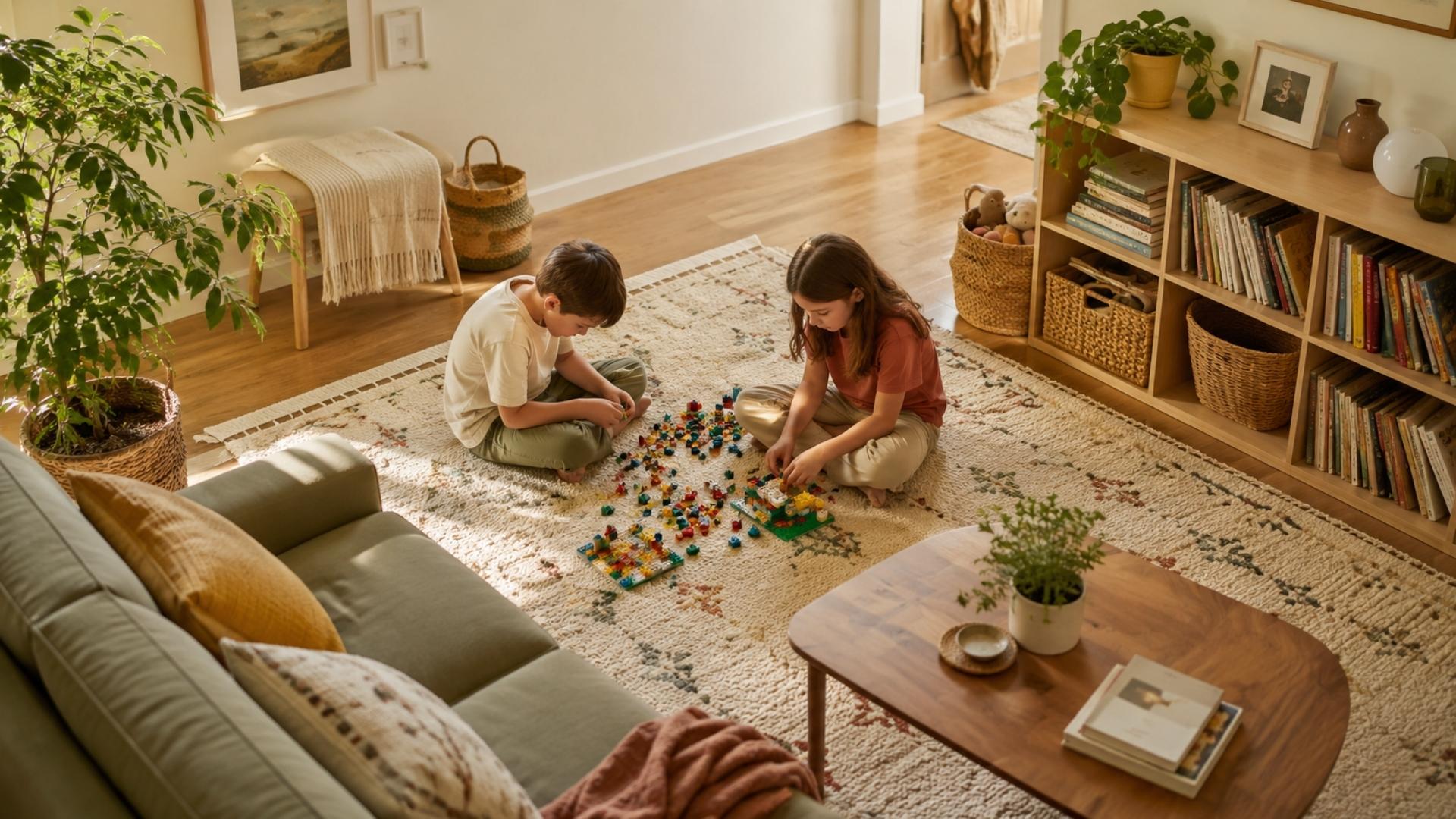
Apartment playdates have specific constraints. The downstairs neighbour. The 4-foot stretch of clear floor. The lack of garden as the run-around-and-burn-off-energy backup. These are real, but they are not show-stoppers. Quiet does not have to mean boring; small does not have to mean un-fun. Here are 14 activities that absorb two kids in a tight space without producing the late-afternoon noise complaint.
The apartment playdate constraints (and why most generic guides ignore them)
Most playdate advice assumes a house. A garden as the energy-release valve. A separate playroom. A floor where jumping is fine. Apartment families know this advice does not transfer; the noise-on-the-floor that is invisible at home is a complaint at the apartment, and the run-around-the-yard option does not exist.
Three real apartment constraints that change the playdate format.
- Downstairs neighbour. Jumping, running, dropping things on the floor produces noise the people below hear immediately. Not theoretical; they will text or knock.
- Limited floor space. The clear floor area might be 4 by 6 feet. That is enough for some activities and not enough for others.
- No outdoor escape valve. When the energy needs to go somewhere, you do not have a backyard to send the kids into. The pivot is leaving the apartment, which has its own logistics.
If you are still building out the broader playdate playbook, our complete guide to playdates covers the bigger picture. This piece is the apartment-specific layer.
For the broader play-space-in-a-tight-apartment design question (toy storage, play zones, multi-purpose furniture), our guide to setting up a play space kids actually use has the small-apartment section that pairs with this piece.
"Quiet" does not mean "boring" (the reframe most parents miss)
The reflexive thought when an apartment playdate has to stay quiet is: this is going to be a slog of forced low-energy activity. It does not have to be.
Quiet absorbing activities exist in abundance. Construction (LEGO, magnatiles, blocks). Art (drawing, painting, sticker mosaics, collage). Pretend play (dolls, action figures, restaurant, vet clinic). Reading and audiobooks. Card games and short board games. Cooking together. The only thing missing from the typical home-playdate menu is the running-around-on-the-floor block; the other 80% transfers cleanly.
What apartment playdates do not have, that house playdates do, is the lower-cost ability to switch between quiet and loud activities. At home, you can do 30 minutes of LEGO and then 30 minutes of floor-is-lava. In an apartment, you do 30 minutes of LEGO, then 30 minutes of art, then 30 minutes of pretend play. Same length, different mix.
Once you stop trying to do the loud activity in a quiet space, the apartment playdate works. The problem is rarely the activities; it is the parent trying to make a noisy activity work in a quiet venue.
The 14 quiet activities that absorb two kids in a small space
Sorted by what they require and roughly by absorption length.
Construction and building (5 ideas).
- LEGO. The single best apartment-playdate activity. Two kids, one shared bin or two baseplates each, 60-90 minutes of focus.
- Magna-Tiles or magnetic tiles. Engineering, ramps, marble runs. Quiet, absorbing.
- Block towers (wooden blocks or duplo). Shorter activity for younger kids; pile-and-rebuild beats nothing.
- Marble runs (ready-made sets). Endless variations.
- Cardboard box engineering. Save a big box. Markers, scissors, tape. Becomes a fort, vehicle, restaurant. Low-noise high-creativity.
Art and craft (5 ideas).
- Drawing or sketching. Plain paper, markers or coloured pencils, two kids at a small table. Hours of activity if they are into it.
- Sticker mosaics. A sheet of paper, a pile of stickers, a prompt (a cat, a garden, your name in stickers). Zero mess.
- Watercolour postcards. Watercolour paper, washable watercolours, brushes. Each kid makes a card per family member.
- Friendship bracelets (older kids). Embroidery floss, simple braid pattern. Quiet, focused, can sustain 60+ minutes.
- Air-dry clay sculpting. A small block per kid on a placemat. They sculpt for 30-45 minutes; you let it dry on a tray.
Pretend, games, and reading (4 ideas).
- Pretend play: restaurant, vet clinic, doctor, post office. Same setups as anywhere else; works fine in a small space.
- Card games and short board games. Uno, Spot It, Memory, Sushi Go, Catan Junior. 30-45 minute games, quiet to play.
- Reading or audiobook with colouring. One audiobook playing, two kids on the rug colouring. 30+ minutes of calm.
- Cooking or baking together. Kitchen counter, a recipe, two kids in aprons. The kitchen is the quietest room in most apartments and the most absorbing activity.
Pick 3 to 4 for a 90-minute playdate. Cycle through; do not try to fit all 14 in one afternoon.
Floor-noise management (the basics that prevent complaints)
Most apartment-noise complaints are about footfall and dropped items, not voices. Voices carry through walls less than people fear; footsteps and dropped things carry through floors more than people realise.
Five floor-noise moves that prevent most complaints.
- Rugs in the play area. A thick rug on top of a thin one (or a thick rug with a felt rug pad underneath) absorbs footfall significantly. The rug is the single biggest investment.
- House-shoes or socks for kids. Hard-soled shoes amplify every step. Either kids in socks or kids in soft slippers; no outdoor shoes inside during the playdate.
- Soft-toy floor zone. Small toys dropped on a rug make less noise than dropped on bare floor. Encourage play on the rug, not on the bare floor next to it.
- Avoid the activities that produce floor impact. Jumping. Wrestling. Running games. Floor-is-lava with cushions. Dance-freeze with thumping. These are the high-complaint generators; save them for outdoors or weekend daytime when neighbours are out.
- If something heavy drops, do not pretend it did not. The neighbour heard it. A quick text to the downstairs neighbour ("sorry, kid playdate, big block fell, all good") usually defuses the moment far better than silence.
If you have a high-energy kid who genuinely needs to burn physical energy and the apartment cannot accommodate it, our guide to indoor activities for high-energy kids has a specific apartment-quiet section with movement options that do not produce floor noise.
The 3pm to 5pm window: when to schedule, when to skip
Apartment playdate timing matters more than house playdate timing. The right time slot avoids most neighbour conflict.
Best windows.
Saturday or Sunday morning (9am to noon): neighbours often out, less noise pressure. Weekday late mornings (10am to noon): work-from-home neighbours have settled into their routine and are tolerant. Early evenings (5pm to 7pm): dinner hour is forgiving across most apartment buildings.
Trickier windows.
Weekday afternoons (2pm to 5pm): some work-from-home neighbours are on calls; tolerance is lower. School-holiday weekday afternoons can be okay if other apartment kids are also home and noisy. Saturday afternoons: variable; some buildings have a quiet-afternoon culture.
Worst windows.
After 8pm: nearly all noise becomes a complaint. Before 8am on weekends: similar issue from the other direction. During known quiet hours (most buildings have these listed in the lease).
If your building has known noise rules or a recent complaint history, schedule defensively. The 90-minute Sunday morning playdate is the lowest-friction format; lean into it.
Multi-purpose setups for studios and one-bedroom apartments
If your apartment is genuinely small (studio, one-bedroom, less than 400 square feet of usable common space), the playdate format adjusts to fit the space.
Three setups that work in tight spaces.
- Coffee table as the activity hub. The coffee table becomes the LEGO platform, the art table, the snack table. Two kids can sit on the floor on either side. Most-flexible single piece of furniture in a small apartment.
- Bedroom bed as the play zone. Stripped bed (just a fitted sheet) becomes a soft surface for board games, drawing, building, reading. Comfortable, contained, easy to reset.
- Kitchen counter as the cooking-and-eating zone. A baking project at the counter is one of the highest-yield activities in any small apartment. Occupies 60+ minutes, produces a snack, contains the mess.
What to skip in a small space. Activities that require the kids to spread out (treasure hunts across multiple rooms, big-prop pretend play, anything with a 6-by-6-foot floor area). Save these for a friend's bigger house or the local library's craft room.
Storage tricks: bringing it out, putting it away
Apartment playdates do better with the bring-out-then-put-away rhythm than with the everything-is-out approach. Limited surfaces and floor area mean every activity needs to be reset before the next one.
Three storage tricks that make this practical.
- One bin per major category, low and accessible. A LEGO bin, an art bin, a pretend-play bin. Each kid can pull one out at a time; everything else stays away.
- A rolling cart for art supplies. Rolls out for the activity; rolls back into a closet or under a counter when done. 90% of the friction of art-in-a-small-space disappears with the rolling cart.
- Pre-portion the snack on the counter, not the playdate plates. The snack platter sits on the kitchen counter; kids serve themselves into small bowls when called over. Saves the dining table for the next activity.
The reset between activities should take 5 minutes max. If it is taking 15, the system is wrong; not enough bins, not labelled, kid does not know what goes back where. Worth investing one hour in re-organising the play storage; pays back across every playdate.
When to leave the apartment (alternative venues)
Some playdates should not happen in the apartment at all. Long playdates with high-energy kids. Playdates during noisy-construction-day-in-the-building. Playdates when the kids are at the bouncing-off-walls saturation point. Playdates that need outdoor space to actually work.
Five out-of-apartment alternatives that work for urban families.
- Local park. The closest playground or green space within a 10-minute walk. Lowest-effort venue switch.
- Library children's section. Most libraries have story times, LEGO clubs, and quiet-but-welcoming play spaces.
- Children's museum or science centre. Best for the rainy-Saturday alternative. Free or low-cost.
- Indoor playground or soft play. Best for the high-energy weekend alternative.
- Building common rooms or rooftops. Many apartment buildings have a common room, roof terrace, or shared garden that can be booked for a couple of hours. Underused; ask the building manager.
For the broader logistics of out-of-home playdates, see our guides to park playdates, indoor playground playdates, and library, museum, and coffee shop playdates. The leave-the-apartment toolkit is well-developed.
If you find yourself defaulting to out-of-apartment for most playdates, that is fine. Many urban families do almost all of their playdates at parks, libraries, and museums and only host at home occasionally. Apartment-as-host is one option among many; do not feel obligated to host more than works for your space.
Frequently asked questions
Are screen activities the answer for apartment playdates?
As a small fraction, yes; as the main activity, no. Screens are quiet (good for apartments) but produce parallel-not-shared engagement (bad for friendships). Use a single co-screen activity (one show, both kids watching together; one game, both kids playing together) for 20-30 minutes max during a 90-minute playdate. Avoid solo headphone time; that is parallel internet, not a playdate.
How do I handle neighbours who complain even when we are being quiet?
Some neighbours are noise-sensitive in ways that no realistic kid behaviour can fully accommodate. Three moves: respond politely the first time and adjust what you can (more rugs, no jumping). Document your noise efforts in case it escalates. If complaints continue despite genuinely quiet playdates, the issue is the neighbour's threshold, not your kid; talk to the building manager about reasonable noise expectations for a residential building. You are not obligated to live in silence because someone downstairs prefers it.
What about high-energy kids in small apartments?
Build movement into the schedule outside the apartment. Walk to the park before the playdate to burn energy. Schedule a longer outdoor segment in the middle. Use the apartment for the calmer second half. Some kids genuinely struggle with the apartment-only playdate format; those families do better with a default of meeting at parks, museums, or community spaces.
Are rooftop or shared building spaces good for playdates?
Often excellent and underused. Shared rooftop, communal garden, building lounge, party room. Ask the building manager about availability and rules. These spaces give you the social privacy of a private playdate with the noise tolerance of a non-residential space.
How many kids is too many in a small apartment?
Two kids is comfortable in nearly any apartment. Three is a stretch in studios or one-beds; doable but the third kid often gets restless. Four or more should be hosted somewhere else. The general rule: if the kids cannot all sit on the floor of the largest room without crowding, you have too many for the space.
Should I warn neighbours in advance about a playdate?
For a regular weekend playdate, no; routine apartment noise is part of urban living. For a bigger event (a small birthday party with 6 kids, a longer playdate that overlaps quiet hours), a heads-up is courteous: a quick note slid under the door or a brief message in the building chat. Most neighbours appreciate the consideration and are forgiving when warned.