
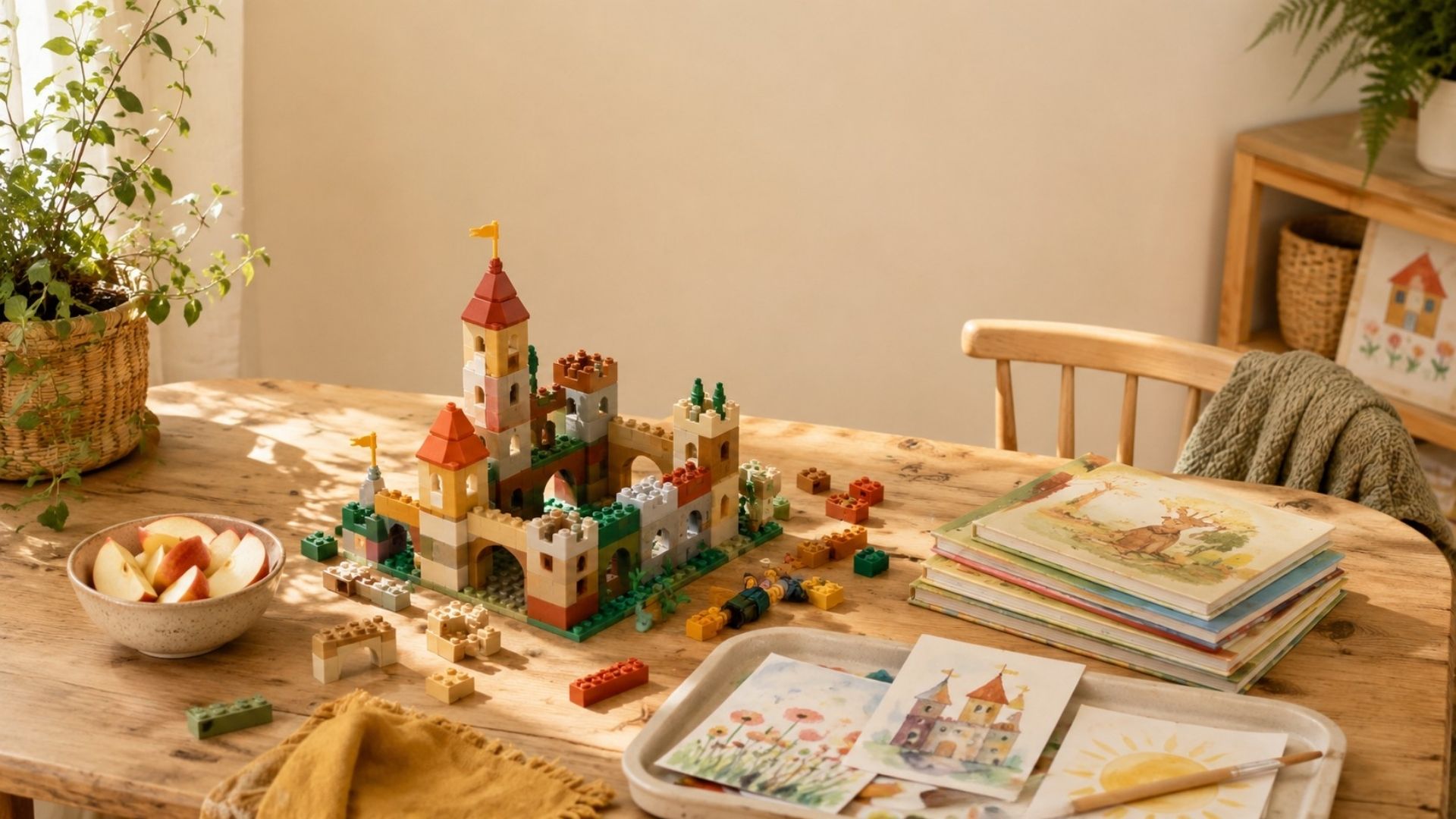
The activities that work indoors are not the most elaborate ones; they are the ones with low setup, low mess, and a clear shape. A 90-minute playdate needs about three: one to start with (calm, focused), one for the energy peak (movement or pretend), and one for the wind-down. Here are 30 activities sorted into those buckets, plus a quick age-and-mess guide so you can pick the right one for your kid and your floor.
How to pick the right activity for the moment
Most indoor playdates fall into three energy phases. The first 20 minutes are settle-in and re-acquaintance. The middle 40 minutes are the peak (where the wrestling, the pretend-play arcs, the elaborate builds happen). The last 20 minutes are the wind-down (snack, quieter activity, pickup window).
Activities that work in each phase are different. Save the elaborate art project for the middle. Save the puzzle for the wind-down. Open with something low-stakes that does not require explanation, like a building set or a book pile.
If you are setting up the playdate from scratch, our guide to hosting a playdate at home covers the broader logistics. This piece is the activity-by-activity menu.
For days when the activity needs to be screen-free or you are dealing with a rainy week, see our screen-free playdate guide and rainy day playdate ideas.
Building and engineering activities
Open-ended building is the highest-yield indoor playdate activity across almost every age. Setup is near-zero, kids self-organise, and a good build can absorb two kids for an hour with minimal adult input.
- LEGO challenge cards. Pre-print or write a few prompts on index cards: "build the tallest tower that holds a book," "build a vehicle with no wheels," "build a house for a tiny animal." Pick one, set a timer, build.
- Magna-Tiles ramps and marble runs. Two kids can build a ramp system with marbles or small cars for an entire afternoon. Add cardboard tubes from the recycling bin for tunnels.
- Cardboard box engineering. Save a big cardboard box. Hand the kids markers, scissors, and tape. Watch it become a spaceship, a fort, or a castle. The single best one-time setup activity.
- Block tower challenge: tallest tower in three minutes, who can knock it down with one ball roll, build a tower then build a copy of it from memory. Three rounds and the kids are absorbed.
- Marble runs (the ready-made sets). Endless variations and good for kids ages four to ten.
- Engineering with kitchen supplies: paper cups, paper plates, masking tape, popsicle sticks, and challenge them to build a bridge that holds a stuffed animal.
Art and craft (low-mess versions)
Art on a playdate has a reputation for being a mess; it does not have to be. The trick is one defined surface (a tray, a covered table, a cookie sheet), washable supplies, and a clear stop point.
- Paper-bag puppets. Brown paper bags, markers, glue sticks, scraps of construction paper. Each kid makes a puppet, then they put on a 30-second show.
- Watercolour postcards. Watercolour paper cut into postcard size, washable watercolours, brushes. Each kid makes one card per friend or family member and writes a short note. Doubles as a thank-you-note activity.
- Sticker mosaics. A single sheet of paper, a pile of small stickers, and a prompt ("a cat," "a garden," "your name in stickers"). Zero mess.
- Salt-dough ornaments. 1 cup salt + 1 cup flour + 1/2 cup water, knead, roll, cut with cookie cutters, bake at 200F until hard. Paint when cool. Two-day project but the active part is 30 minutes.
- Friendship bracelet weaving. Embroidery floss, simple braid or four-strand braid. Good for ages seven and up; younger kids do beaded versions on yarn.
- Paper-plate crafts. Paper plate + paint or markers + scissors becomes a face mask, a sun, a fish, a frisbee. Endless.
- Air-dry clay. A small block per kid on a placemat. They sculpt for 30 minutes; you let it dry on a tray for two days. Paint optional.
Pretend play setups
Pretend play is where playdates actually become friendships. The two kids agree on a story ("we are running a restaurant," "we are vets," "we are spies"), and they sustain it together. Your job is to set the stage and then get out of the way.
- Restaurant. Small table, paper menus, play food or real snacks (crackers, fruit), order pads, a calculator. They take orders from each other and from any nearby grown-ups.
- Vet clinic. Stuffed animals lined up as patients, a doctor kit, paper for charts, masking tape for casts and bandages. The kids diagnose imaginary ailments and prescribe ridiculous cures.
- Spy mission. A list of small "missions" written on slips of paper (find something blue, draw a map of the kitchen, deliver a secret message to the grown-up). They use sneaky voices for an hour.
- Post office. Envelopes, stamps drawn on with markers, a postbox made from a shoebox. They write letters to each other, deliver them, write back.
- Grocery store. Toys or pantry items lined up on a low shelf, paper price tags, a calculator or play money, paper bags. They take turns being the cashier and the customer.
- Theatre or puppet show. Couch cushions or a sheet for a stage, stuffed animals or paper-bag puppets as characters, a 5-minute show for any audience that can be assembled.
Science experiments (kitchen-safe)
Kitchen science experiments are absorbing for the right kid (the curious, observant ones especially) and require almost no special equipment. Two warnings: pick the mess level you can tolerate, and decide upfront if you are doing one or three.
- Vinegar and baking soda volcano. A small bowl, baking soda, a few drops of dish soap, food colouring, vinegar. Pour the vinegar; watch it foam over. Repeat 12 times if needed.
- Skittles rainbow. Arrange Skittles in a circle on a plate, pour warm water in the centre, watch the colours bleed inward into a rainbow.
- Floats or sinks. A bowl of water, a tray of household objects (cork, coin, grape, rubber duck, paperclip, lego). Predict, drop, observe.
- Walking water. Three glasses (two with coloured water, one empty), folded paper-towel strips between them. Wait 20 minutes; the colours migrate. Magic.
- Magnet hunt. A magnet per kid, a basket of small household objects (paperclip, key, plastic toy, coin, rubber band). Sort into magnetic and not.
- Salt crystals. Mix hot water with as much salt as it will dissolve, dip a piece of yarn or a pipe cleaner in, hang to dry. Crystals form over a day or two.
Movement games for inside
Two kids cooped up indoors get loud. Channel the energy into a structured movement game and you buy yourself 15 minutes of focused-loud instead of chaotic-loud.
- Floor is lava. Couch cushions on the floor as islands; the kids hop between them. Rules: feet cannot touch the floor or you are out. Add a complication every 90 seconds (no left foot, only crawling, eyes closed for one jump).
- Indoor obstacle course. Build a course through the living room: crawl under the dining chair, jump over a pillow, balance along a piece of masking tape on the floor, do five jumping jacks, run back. Time them.
- Dance party with freeze. Loud music, dance, pause the music every 20 seconds, everyone freezes. Kid who moves first sits out the next round. Reset every minute so nobody is out for long.
- Balloon volleyball. A balloon, a piece of yarn or a couch as the net. The balloon stays in the air. Easier than a real ball, much less destructive.
- Animal yoga or animal moves. Cat stretch, frog jumps, bear crawls across the room, snake slithers. A yoga-cards deck (Yoga Pretzels or similar) makes this a 20-minute activity.
- Hide and seek (the indoor version). Set boundaries (one floor only, off-limits to bathrooms or your bedroom). Three or four rounds is a full activity for ages four and up.
Quiet activities for the wind-down
The last 20 minutes of a playdate should be calmer than the middle. A quieter activity buys you a buffer for snack, cleanup, and the parent who is about to come pick up.
- Reading time. A pile of picture books, two beanbags. Each kid picks one to look at or read. Quiet, restful, often surprisingly absorbed.
- Puzzles. A 50-piece or 100-piece puzzle (matched to the younger kid's level) on the floor or table. Two kids can work on one puzzle together; a great wind-down for grade-schoolers.
- Audiobook or podcast for kids. A 15-minute story (Story Pirates, Wow in the World, classic audiobooks) playing on a small speaker. Lay out a colouring tray; let them listen and colour.
- Card games. Uno, Go Fish, Spot It, Memory. One game lasts about 15 minutes and ends cleanly.
- Lego or block building (just one). One bin out, one shared baseplate. Quieter than the build-and-knock-down game from the high-energy section.
- Drawing or doodling on a giant piece of paper. Roll out a big sheet of paper or butcher paper across the floor or table, hand each kid a marker, let them fill it together.
Activities by age (the cheat-sheet)
Same activity does not work for every age. Here is the rough match.
Ages two to three. Big-block towers, paper-bag puppets, water-table play (set up indoors on a tray), simple obstacle courses, sticker mosaics, paint with brushes, hide and seek with very obvious hiding spots, one-step pretend play ("feed the bear").
Ages four to five. LEGO duplo, magnatiles, dress-up, restaurant or vet pretend play, salt-dough, simple kitchen science (volcano, floats or sinks), dance freeze, animal yoga, picture-book reading, simple puzzles up to 50 pieces.
Ages six to eight. LEGO challenges, magna-tile engineering, board games and card games (Uno, Spot It, Sushi Go), elaborate pretend play (spy missions, post office), salt crystals, watercolour postcards, friendship bracelets, hide and seek with strategy, podcasts and audiobooks.
Ages nine to twelve. More complex LEGO sets or builds, board games (Ticket to Ride, Codenames Junior, Catan Junior), DIY craft kits, science kits, elaborate art projects, baking together, structured games like Pictionary or charades, longer card games like Skyjo, podcast listening with a big shared art project.
Mixed-age groups: pick an activity that works for the youngest kid; the older kids will adapt. The reverse rarely works.
Mess level: pick what your floor can handle
Be honest about how much mess you can tolerate today. The activities above range from zero-mess to disaster-zone. The rough sort:
Zero mess. Card games, board games, puzzles, reading, audiobooks, hide and seek, dance freeze, yoga, building with LEGO or magnatiles, sticker mosaics.
Low mess (a wipe-down at the end). Watercolour postcards, paper-bag puppets, paper-plate crafts, vinegar volcano (in a tray), Skittles rainbow, walking water, balloon volleyball, indoor obstacle course.
Medium mess (10-minute cleanup). Salt-dough ornaments, air-dry clay, friendship bracelets with beads, cardboard-box engineering with markers, restaurant pretend play with real snacks, dance freeze with confetti.
High mess (set up on a tarp or do it outside). Free-pour painting, slime-making, baking together, glitter projects, full-blown sand or water play indoors.
On a low-bandwidth day, stick to zero or low mess. Save the medium and high for when you are feeling generous and the cleanup is not on top of dinner prep.
Frequently asked questions
How many activities do I need to plan for a 90-minute playdate?
Two to three. One settle-in (low-stakes, low-prep), one peak (the longer, more absorbing activity), and one wind-down. Do not over-plan; if the kids are absorbed in the peak activity, let it run.
What if the kids reject every activity I suggest?
Pull back and let them be bored for 10 minutes. Most kids find their own play within a few minutes if you stop offering. The activities above are backup options, not a strict menu. If true rejection lasts more than 15 minutes, drop a single open-ended thing on the floor (a basket of LEGO, a few markers and paper) and walk away.
How much should I supervise vs. step back?
Setup yes, supervise yes (you are nearby and listening), but do not direct the play. Most kids ages four and up self-organise within five minutes if the materials are there. Hover and you become the activity, which is exhausting for everyone.
What activities work best for kids who do not know each other well?
Side-by-side activities first (drawing on a shared piece of paper, building separate things from a shared bin of blocks). Forced-collaboration activities (one shared puzzle, one shared pretend story) work better once the kids have warmed up, usually 15 to 20 minutes in.
Are baking and cooking activities good for playdates?
Sometimes. Baking together is great for kids age six and up if you have the time and patience for a 60-minute cook-and-clean cycle. For younger kids, decorating pre-made cookies is the better version. Skip if the playdate is short or the kitchen is small.
How do I know when an activity has run its course?
When the energy starts dropping or the conflict starts rising. Both signal the activity is done. Pivot to the next phase (snack, wind-down activity, or close out) before things go sideways. Most activities have about a 25-to-40-minute runway with two kids; do not push past it.