
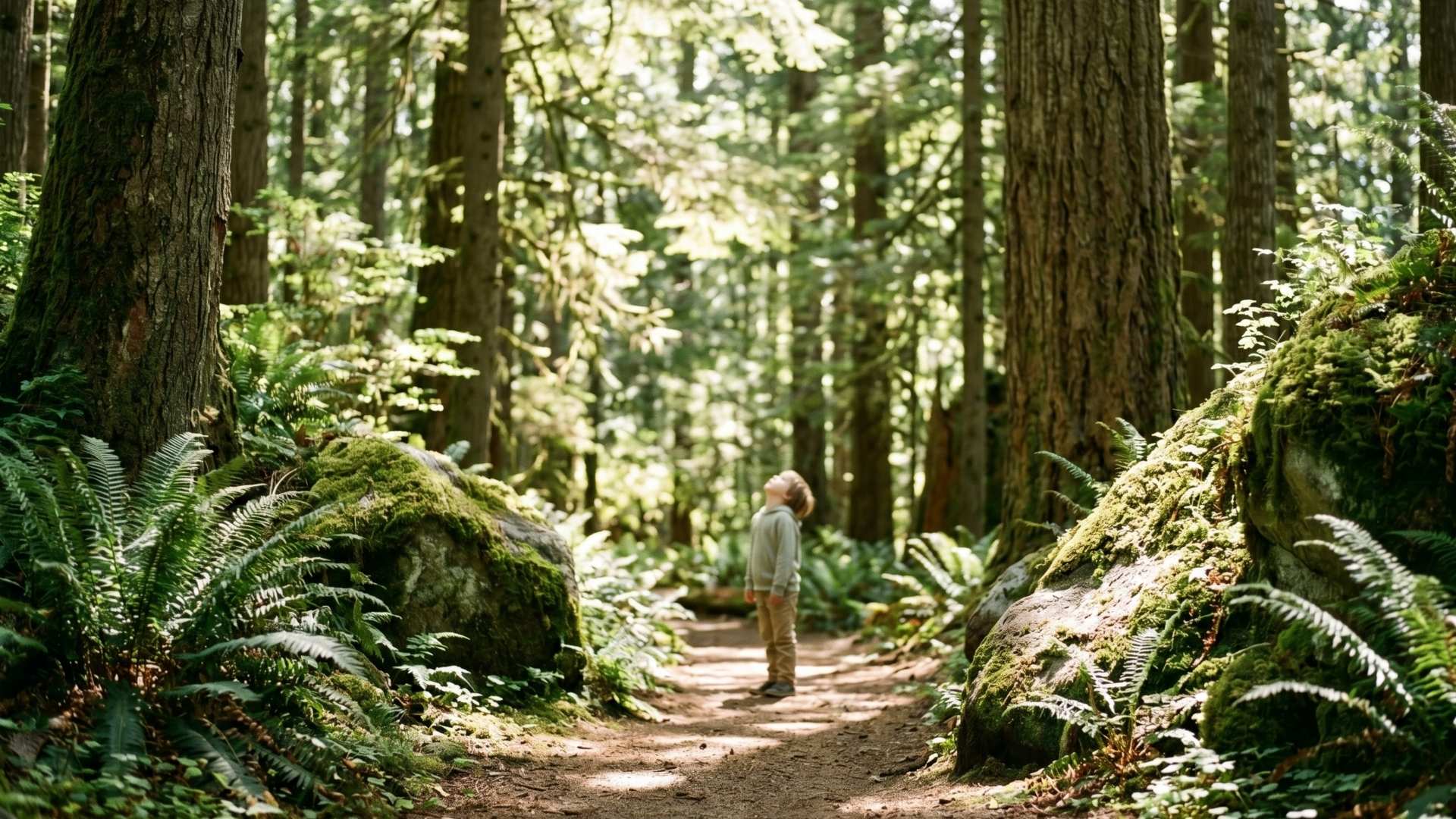
Forest bathing is the Japanese practice of shinrin-yoku, and it sounds more elaborate than it is. You walk slowly through a wooded area. You stop often. You notice things. You leave the phone in the car. Done with kids, it is one of the most reliably calming family activities available, with research-backed effects on cortisol, mood, and sleep. Here is the simplest version that works, by age, with where to find a good spot.
What forest bathing is (and what it is not)
Forest bathing is not hiking. It is not a fitness goal, not a route, not a destination. There is no map. You walk slowly, pause often, and use all five senses to notice what is around you. A 90-minute family forest bath might cover less than a kilometre on the ground.
It is also not meditation in the formal sense. You are not sitting still with your eyes closed; you are walking, looking, listening, touching bark, smelling moss. The mental effect is similar to meditation (slowed-down, more present, less anxious), but the practice is movement-based and easier for kids who cannot sit still.
The Japanese term is shinrin-yoku (literally "forest bath"). It was developed as a public-health intervention in Japan in the 1980s, became a formal therapy by the 2000s, and is now an evidence-backed practice studied in dozens of peer-reviewed papers.
What the research actually shows
Forest bathing has measurable physiological effects. Studies on adults consistently show:
- Lower cortisol (the main stress hormone) within 30 to 60 minutes in the forest, with the effect lasting hours afterwards.
- Lower blood pressure and heart rate during and after a forest walk.
- Improved mood, with reductions in anxiety and depressive symptoms after consistent practice.
- Better sleep that night for most participants.
- An immune-system boost from inhaling phytoncides (the airborne chemicals trees release), with effects measurable for several days after a long forest walk.
Research on children is smaller in volume but consistent in direction: time in green space correlates with lower stress reactivity, better attention, and improved mood. The effect is dose-dependent (more time matters), and unstructured nature time matters more than structured outdoor activity (a hike with a goal does less than a slow wander).
The Children & Nature Network research library is the best curated source if you want to read the underlying studies. The short version: time in the woods is one of the simplest, cheapest, most reliably effective things you can do for a kid's nervous system.
How to do it with kids: the simple version
Forest bathing with kids does not need a guide, an app, or a workshop. The basic practice is six steps, repeatable across any age.
- Find a wooded area. A forest is best; a wooded park, a tree-lined trail, or a botanical garden also work.
- Leave the phone in the car (or at least on aeroplane mode in your pocket). The point is to disengage from the schedule.
- Walk slowly. Slower than you would normally walk. Slower than the kids would normally walk. The pace is part of the practice.
- Pause often. Every couple of minutes, stop for 30 seconds. Notice what is around you.
- Engage the senses. Touch bark, smell crushed leaves, listen for birds, watch how light filters through the canopy. With kids, give specific prompts: "What is the loudest sound you can hear right now?" "Find me three different leaf shapes."
- Do not insist on conversation. Quiet stretches are part of the practice. Kids will naturally chatter for the first 15 minutes and then often go quiet, which is the practice working.
A first session might be 30 minutes. A practiced family can do 90 minutes to two hours. Anything over an hour starts to produce the deeper calming effects most people are after.
Best time of day, best weather
Time of day matters less than you might think. Morning, midday, and late afternoon all work; the experience just changes character. Morning is birdsong-heavy and cool. Midday is warm and bright; the canopy filtering is at its strongest. Late afternoon is quiet, often uncrowded, and golden-light beautiful.
Weather matters more. Sunny, calm days are the easiest entry. Light rain is genuinely lovely once you commit (the smell of a wet forest is half the practice; bring waterproofs and embrace it). Skip windy days (kids cannot hear the small forest sounds and limbs falling are a real risk in storms) and skip days with extreme heat or cold.
Best season depends on your hemisphere and what you want from the experience. Spring is leaf-emergence and birdsong. Summer is full canopy, deep shade. Autumn is colour and the loudest leaf-rustle underfoot. Winter is bare branches, quieter forests, often the most contemplative season for a family forest walk. All four work; the practice does not.
Forest bathing by age
Toddlers (18 months to 3 years).
Short and sensory. 20 to 30 minutes, lots of pausing, lots of touching things. Hand them a specific job: "Find me a leaf that is bigger than your hand." "Find me a smooth rock." Do not expect quiet contemplation; do expect a slowed-down, absorbed kid by the end. Bring a small backpack of "forest finds" for the kid to collect.
Preschoolers (3 to 5 years).
30 to 45 minutes. They can engage with sensory prompts ("close your eyes for 10 seconds and tell me three sounds you hear"). Build in a few sit-down moments on a fallen log. Give them a magnifying glass; they will use it for an hour. Keep prompts open-ended.
School-age (6 to 9).
45 to 75 minutes. They can sustain longer quiet stretches. Add nature-journal-style prompts: "Sketch the most interesting leaf shape you find." Ask them to find specific things (a bird nest, a fungus, a tree taller than the house). They start to recognise the calm-after-an-hour effect on themselves around this age.
Tweens (10 to 12).
75 minutes to two hours. Full silent stretches work; they will often choose to walk a little ahead or behind, which is fine. Frame it as a "phone-free family time" they get to choose what to look at. The benefit they notice most is the focus shift afterwards (homework, conversation, sleep all easier the evening after a long forest walk).
Mixed ages: adapt to the youngest kid's pace. The older kids will adjust faster than you expect; many will use the slower pace as a chance to actually look at things they would normally rush past.
Where to find a good forest spot
You do not need a designated forest reserve; you need trees, paths, and quiet. Most regions have free public options within a 30-minute drive of any town.
If you are in the UK.
The Forestry England "forest finder" and the equivalent Forestry and Land Scotland both maintain searchable maps with family-friendly ratings, accessible car parks, and toilet facilities. The Woodland Trust runs Tree.com and a similar finder for woodlands across England, Wales, Northern Ireland, and Scotland.
If you are in the US.
The US Forest Service "find a forest" map covers national forests; local state-park websites cover the rest. AllTrails filtered by "easy" + "loop" + your zip code is the fastest way to find a wooded path within driving distance.
If you are in Canada, Australia, or New Zealand.
Parks Canada, Parks Australia, and the New Zealand Department of Conservation all maintain searchable site maps with family-friendly filters. Most have free entry to many parks and reserves.
If none of the above apply.
Look for: a public botanical garden with a wooded section, a local arboretum, a tree-lined section of a park you already know, or a section of a long-distance trail you can walk a kilometre into and back. The forest does not need to be vast; even a 10-acre wooded park is enough to disappear into for an hour.
Things to leave at home (and a few to bring)
Leave at home:
Phones (or at minimum, on aeroplane mode in a pocket). Headphones. The packed-itinerary mindset. The fitness tracker if you can bear to skip the steps for one outing. Snacks for the kids if it is a short walk; the snack request becomes the focus and breaks the practice. The loud water bottle that clanks against the carabiner.
Bring:
Water (in a quiet bottle). A small backpack for forest finds. A magnifying glass for younger kids. A blank notebook and a pencil for older kids who like to sketch. Layers (forests are cooler than open ground). Sturdy shoes. A printed map of the area, or downloaded offline; once the phones go away, no GPS.
When forest bathing becomes a family habit
The research benefit is dose-dependent. One forest walk feels nice; a weekly forest walk for three months changes things. Most families who make it a habit notice three things.
- The kids ask for it. After 6 to 8 sessions, the older kids start suggesting it. "Can we go to the woods this weekend?" becomes a sentence you hear. The under-fives sometimes resist initially; they almost always end up loving it within 4 sessions.
- The post-walk effect lasts longer. The first walk produces calm for the rest of that afternoon. By session 6, the calm extends into the evening and the next morning. Sleep that night is reliably better.
- Family conversations improve. Walking side by side in the quiet is the social-anthropology magic of forest bathing. Hard topics come up more easily; kids tell you things they would never say across the dinner table.
How often: once a week is the sweet spot for noticeable effects, but every other week works too. Once a month is enough to keep the habit alive but not enough to produce the cumulative benefit. Pick a regular slot (Sunday morning, Saturday afternoon) and protect it.
If you cannot do a real forest weekly, a substitute partial-effect: a 30-minute slow walk in any green space (a city park, a tree-lined avenue, a botanical garden) hits some of the same notes. The full forest is better, but the daily green-space walk is most of what matters in research terms.
Frequently asked questions
Will forest bathing work if my kid is anxious or sensory-sensitive?
Often yes, sometimes with adjustments. Most anxious kids find forests calming, especially after the first 15 to 20 minutes. Some sensory-sensitive kids find specific elements hard (insect noises, uneven ground, the dampness in damp weather); start short, in dry weather, on a wide easy path. If your kid responds badly to the first attempt, try a different forest before concluding it does not work for them.
Is one walk enough to feel a difference?
You will likely feel something after a single 60-minute walk: lighter mood, slower thinking, easier sleep that night. The bigger effects (lower baseline anxiety, better long-term sleep, more focus in the kids) come from regular practice over weeks. Treat the first walk as a sample; the real benefit is in habit.
Can we do forest bathing in the snow?
Yes, and it is one of the most peaceful versions. Snowy forests are quieter (snow muffles sound) and visually stunning. Bring proper layers, bring grippy boots, shorten the walk to 30 to 45 minutes, and accept that you will need a hot drink waiting in the car. Many families who try winter forest bathing prefer it to summer.
What about ticks, mosquitoes, and other forest pests?
Real considerations in some regions and seasons. Long sleeves and trousers in tick season, tucked into socks. A natural insect repellent on exposed skin in mosquito season. Check the kids (and yourself) for ticks at the end of any walk through tall grass or undergrowth. The risk is real but manageable; do not let it stop the practice.
Does it count if the woods are right next to a road or a city?
It counts. The full benefit is greater in remote forests but a wooded urban park or a city botanical garden produces real measurable effects. The trees do most of the work; the silence is a bonus, not a requirement. If you can hear traffic, focus on the closer sounds (birds, leaves underfoot, your own footsteps); the brain adjusts.
Is forest bathing for kids different from just "taking a hike"?
Yes, by intention and pace. A hike has a destination and a pace; forest bathing has neither. A 90-minute hike covers 5 km; a 90-minute forest bath might cover under 1 km. The slower, prompts-based, sensory-focused practice produces the cortisol drop and the calming effect; a brisk hike gives you exercise and views but a different physiological signature. Both are good; this is the slower one.