
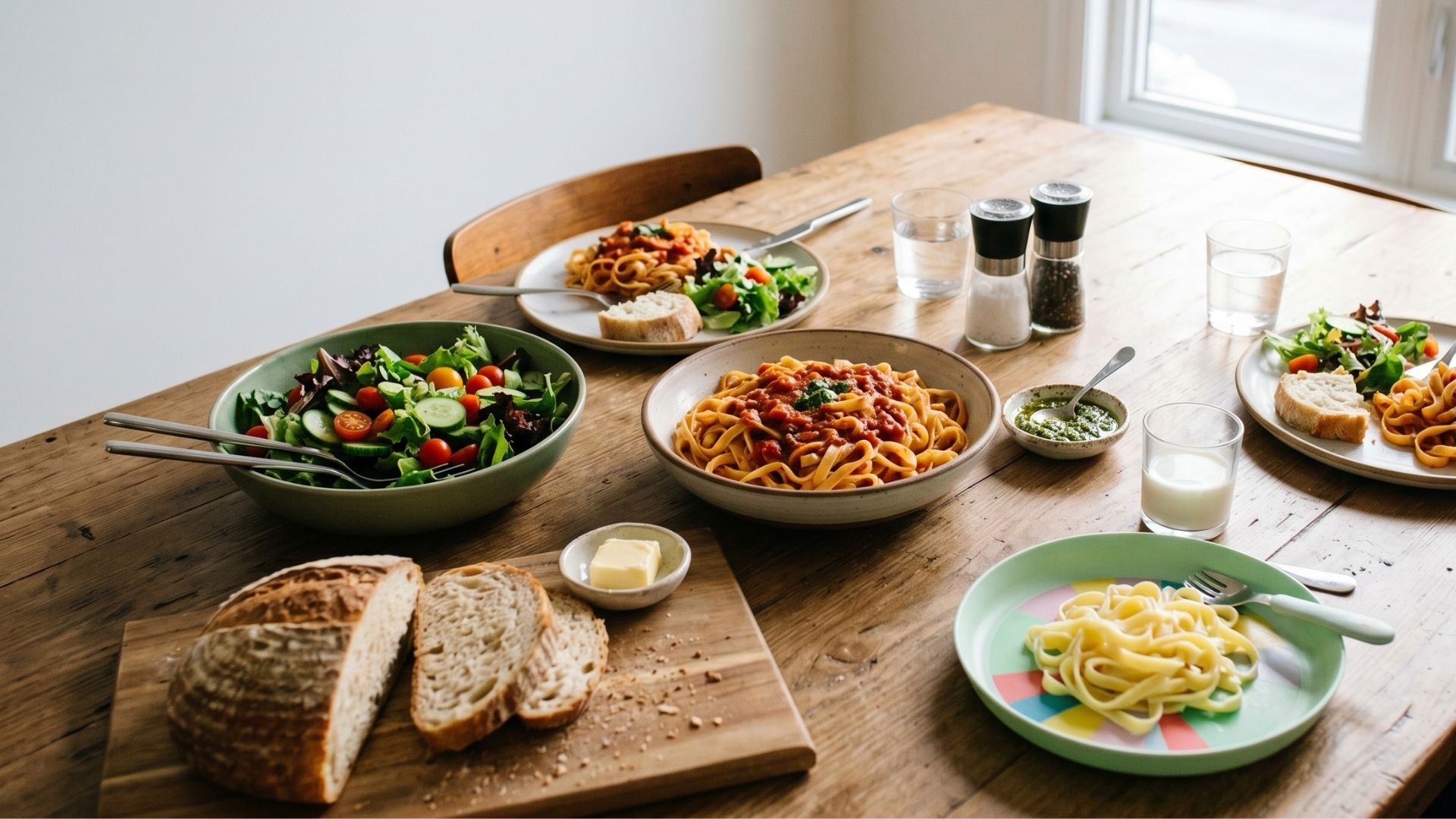
The hardest dinner is the one where you cook two meals: one for the adults and one for the picky kid. Most family dinners do not need to be either-or. The 30 dinners below all share one feature: they have one component every kid eats and one component the adults can dress up. Cook once; serve a version everyone wants. Here are the 30, sorted by category, with the build-your-own format that ends most dinner battles.
The shared-meal principle
The single biggest meal-time fix is to stop cooking two dinners. Cooking two meals (one for the picky kid, one for the rest of the family) doubles your work, normalizes the kid's narrow menu, and produces resentment on both sides over time.
The shared-meal principle is the alternative. One dinner; multiple acceptable ways to eat it. The kid eats the plain version (pasta with butter and cheese, taco shells with just chicken, rice with soy sauce). The adults eat the dressed-up version (pasta with garlic sauce and broccoli, tacos with all the toppings, rice with stir-fry vegetables). The Ellyn Satter Institute on the division of responsibility is the foundational research on this approach. Parents decide what is offered; kids decide how much (and which of the offered components) they eat.
If picky eating itself is the bigger issue in your house, see our guide to picky eating: what works and what makes it worse. This piece is the recipe-and-format companion.
Pasta and grain bowls (5 dinners)
Pasta and rice bowls work because the base is universally accepted by picky kids and the topping bar is where the adult version diverges.
- Pasta with butter, parmesan, and a side bowl of tomato sauce. Kid eats plain; adults add sauce, garlic, chili flakes, basil.
- Spaghetti and meatballs (use a passable jarred sauce; meatballs are the universal kid food). Adults add a salad on the side.
- Pesto pasta with chicken. Kid takes pasta plain or with butter; adults take it with pesto and chicken.
- Rice bowls with chicken or tofu. Plain rice plus protein for the kid; adults add stir-fried vegetables, soy-ginger sauce, sesame seeds.
- Mac and cheese with a side of broccoli. Adult version: cracked black pepper and a small side salad. Always works.
Stir-fries and one-pan dinners (5 dinners)
One pan, vegetables and protein cooked together, rice or noodles on the side. Most stir-fries can be deconstructed (kid takes plain rice and unseasoned chicken; adults take the seasoned mix) without a second cooking effort.
- Chicken stir-fry over rice. Kid version: plain rice and plain chicken pieces. Adult version: full stir-fry with vegetables and sauce.
- Beef and broccoli over rice. Same deconstruction.
- Lo mein noodles with chicken and vegetables. Kid takes plain noodles; adults add the full mix.
- Sheet-pan sausage and roasted vegetables. Kid takes the sausage; adults take sausage plus roasted carrots, peppers, sweet potato.
- Sheet-pan salmon, potatoes, and asparagus. Kid version: salmon and potato. Adult version: all three.
Tacos, wraps, and bowls (5 dinners)
Build-your-own dinners are the highest-yield format for mixed-eater families. Set out the components; everyone makes their own version. Kid takes only the bits they like; adults take everything.
- Taco bar (ground turkey or beef, soft tortillas, cheese, lettuce, tomato, salsa, sour cream, beans, avocado). Kid takes meat and tortilla; adults take the loaded version.
- Burrito bowls (rice, beans, chicken, peppers, cheese, salsa, lettuce, sour cream). Kid takes rice and chicken; adults take the bowl.
- Pita pockets with hummus, falafel or chicken, cucumber, tomato. Kid: pita and chicken. Adults: full Mediterranean version.
- DIY pizza night (pre-made dough or naan, sauce, cheese, choice of toppings). Each kid makes their own; adults make adult pizza with arugula, prosciutto, etc.
- Grain bowls (quinoa or rice, protein, choice of toppings: roasted vegetables, beans, avocado, cheese, dressing). Kid takes the basics; adults build the bowl.
Soups and stews (5 dinners)
Many picky kids do not love soup; serve the components separately for them. Bread, plain pasta, or rice on the side gives them something to eat while adults have the soup.
- Chicken noodle soup with crusty bread. Kid: noodles, chicken pieces, bread. Adults: full soup.
- Tomato soup with grilled cheese. The grilled cheese is the universal kid component; soup is for dipping.
- Lentil soup with crusty bread and cheese. Kid: bread and cheese. Adults: full bowl.
- Italian wedding soup. Kid: meatballs and pasta from the soup. Adults: full bowl.
- Slow-cooker beef stew with mashed potato. Kid: meat and potato. Adults: full stew.
Crowd-pleasers (5 dinners)
These are the dinners that work for almost every family every time. Default to one of these on a low-bandwidth weeknight.
- Roast chicken with potatoes and a vegetable. The classic; almost no kid refuses roast chicken.
- Burgers and fries (or sweet potato fries). Even fancy adults eat the burger; kids eat the burger.
- Pancakes for dinner. Sometimes the right answer is breakfast at 6pm. Adults get fruit and yogurt on the side.
- Quesadillas with rice and beans. Quick, universal, infinitely adjustable.
- Spaghetti carbonara (or a kid-friendly variation: pasta with bacon and parmesan). Kids love the bacon; adults get the egg-rich sauce.
Build-your-own dinners (5 dinners)
The single most useful dinner format. Set out components; everyone assembles. Reduces complaints; teaches kids about food choice; adults get to eat the way they want.
- Build-your-own salad bar (lettuce, cucumber, tomato, cheese, croutons, olives, chicken, dressing). Most kids will accept a small salad of just things they pick.
- Build-your-own bagel night (bagels, cream cheese, smoked salmon, cucumber, tomato, capers, eggs). Kid version: bagel and cream cheese. Adult version: full deli spread.
- Build-your-own breakfast-for-dinner (eggs, toast, bacon, pancakes, fruit). Each person picks.
- Build-your-own ramen bowl (broth, noodles, soft-boiled egg, scallions, sesame, choice of protein and vegetable). Kid takes plain noodles in broth; adults customize.
- Build-your-own potato bar (baked potatoes, butter, sour cream, cheese, broccoli, chili, bacon, scallions). Universally workable.
When the picky kid eats one component (and that is fine)
Some nights, the picky kid eats only the bread. Or only the rice. Or only the chicken. As long as one item on the table is one they will eat, the meal is working.
Three rules of thumb that prevent the dinner battle without normalizing the kid-only menu.
- Always include one item the picky kid will eat. Bread, plain pasta, rice, a familiar protein, or fruit. Their plate is not empty; they have something to eat.
- Serve everything family-style on the table. Let the kid see the other foods. Do not ask them to try anything; do not insist. Repeated exposure (without pressure) is what builds new-food acceptance over time.
- Eat the new foods yourself, with visible enjoyment. Modeling is more powerful than any encouragement script.
What this looks like across months: the kid who only eats pasta plain at age 4 may try the sauce at age 5, then take it on the side at age 6, then eat the full version at age 7. The shift happens slowly; the parental job is patience and repeated exposure, not insistence. The AAP HealthyChildren guide on family meals covers the broader benefits of shared meals.
The 7-meal rotation (so you do not have to plan from scratch)
Most families eat the same 8-12 dinners on rotation. Embrace it. Pick 7 dinners from the lists above that suit your family; rotate them each week. The kid stops complaining about novelty; the planning load drops to almost zero.
A sample weekly rotation:
- Monday: pasta night (variant changes weekly)
- Tuesday: tacos or burrito bowls
- Wednesday: roast chicken with potatoes and vegetable
- Thursday: stir-fry over rice
- Friday: pizza night (homemade or takeaway)
- Saturday: build-your-own (bagels, salad bar, or breakfast-for-dinner)
- Sunday: a slower-cook meal (roast, stew, sheet-pan, or family soup)
Plan and shop around the rotation, not around novel inspiration. Most parents who plan around inspiration overshop, underuse, and feel decision fatigue every week. The same-rotation approach is the meal-planning version of the capsule wardrobe. For more on the realistic-meal-planning side, see our guide to meal planning for families.
Frequently asked questions
What if my kid will not eat any of these?
Start with the dinners closest to what they already eat. If they live on chicken nuggets and pasta, the first 5 dinners on this list are the most likely to land. Layer in more variety over months, not weeks. New-food acceptance for picky kids takes 10-15 exposures on average; serving the same new dinner once and giving up does not produce learning.
How do I prep these without spending all afternoon in the kitchen?
Pick 7 dinners and prep what you can on Sundays: chop vegetables, cook rice or grains for the week, marinate protein, make pasta sauce in batch. Daily cooking time then drops to 15-25 minutes for assembly and finishing. The Sunday investment is 60-90 minutes; it saves 3-4 hours across the week.
What if my partner is also a picky eater?
Adult picky eating is real and rarely changes. Apply the same shared-meal principle: one dinner with components both adults and the kid will eat. The build-your-own formats work especially well in adult-picky-eater households because everyone gets agency over their own plate.
How do I introduce new dinners without resistance?
Pair a new dinner with at least two familiar components. Spaghetti with a new sauce: serve garlic bread (familiar) and a familiar fruit on the side. The kid has things to eat; the new item is one of three options, not the whole meal. After 5-10 exposures, many kids will try the new item.
Are there dinners I should never bother making?
Highly complex multi-step dinners that take 90 minutes for one meal. Adult-flavour-heavy dinners (curry-heavy, spice-forward) without a kid component. Anything that requires multiple cooking methods at once if you are solo cooking. Save these for special-occasion or kid-free dinners; weeknight cooking should be one method, one pan when possible.
What about kids who refuse to sit at the table?
Set a 15-minute table expectation; the kid does not have to eat, but they have to sit. The shared-meal-time matters as much as the food. Most kids who consistently sit at the family meal eventually start eating at the family meal. Forcing food at the table backfires; forcing presence at the table works.